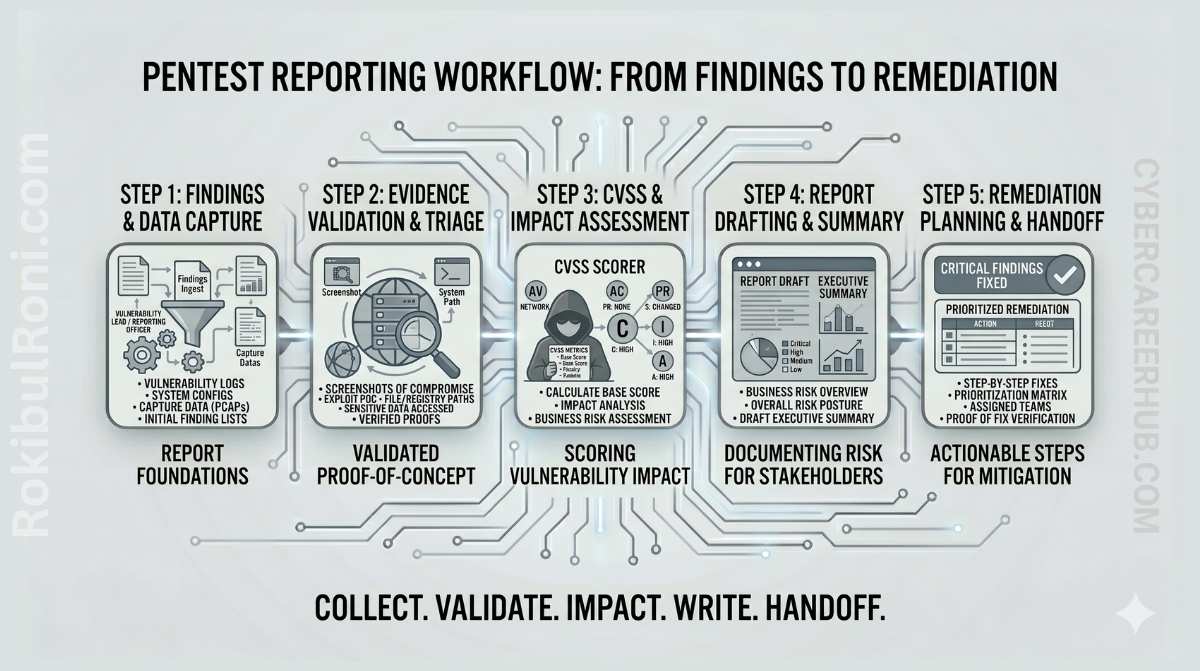
You can run the most thorough pentest in the world, but if the report sits unread or nobody acts on it, the whole engagement was a waste of time. The report is where testing turns into real security improvement. It is the thing that gets bugs fixed, budgets approved, and risks tracked.
Writing a strong report is its own discipline. Finding a critical SQL injection is one thing. Explaining it so a developer knows exactly what to patch, a manager knows why it matters, and an auditor can trace it back to a control gap — that takes a different skill set entirely.
How to write a pentest report
Here is a practical framework for building reports that are technically solid, useful to multiple audiences, and actually lead to fixes.
1) The report is the real deliverable
The goal of a penetration test is not a pile of screenshots or a spreadsheet of CVEs. The goal is a document that drives action.
- It turns raw findings into prioritized work for engineering teams
- It gives business leaders a clear picture of where risk sits right now
- It serves as a point-in-time snapshot for compliance and governance
- It sets the stage for retesting — so you can prove things actually got fixed
- It aligns security, engineering, and leadership around the same priorities
A brilliant pentest paired with a confusing report is just expensive noise.
2) Write for multiple audiences in one document
Your report will land on desks across the organization. Each reader comes to it with a different question in mind.
| Audience | What they are asking | What they need from you |
|---|---|---|
| Executive leadership | ”How much business risk are we carrying?” | Risk themes, severity breakdown, timelines, and who owns what |
| Technical leads | ”Which systems are affected and what do we fix first?” | Asset mapping, prioritized remediation steps, sequencing advice |
| Developers | ”What exactly broke and how do I fix it?” | Reproduction steps, clear evidence, implementation-level guidance |
| Compliance and risk teams | ”Is this documented well enough to satisfy an audit?” | Scope details, methodology, severity rationale, retest tracking |
A well-structured report serves all these readers without making any of them wade through content meant for someone else.
3) Report structure that works in real projects
Consistency matters. When reviewers know where to find things, they spend less time navigating and more time acting.
Recommended sections
- Cover page
- Scope and rules of engagement
- Methodology summary
- Executive summary
- Risk overview and severity distribution
- Detailed findings
- Affected assets and service mapping
- Evidence appendix
- CVSS scoring and rationale
- Business impact mapping
- Remediation plan and ownership
- Retest status and results
- Appendix (references, exclusions, assumptions)
What each section should accomplish
| Section | Purpose | Mistake to avoid |
|---|---|---|
| Scope | Sets the legal and technical boundaries of the test | Listing targets vaguely or forgetting to note exclusions |
| Methodology | Shows how testing was actually performed | Dropping a tool list without explaining the process |
| Executive summary | Gives leadership a quick, honest risk picture | Making it too technical or so generic it says nothing |
| Findings | Delivers actionable technical detail on each issue | Pasting scanner output without analyst interpretation |
| Remediation | Tells teams what to fix and in what order | Saying “apply best practices” instead of giving real steps |
| Retest | Proves whether fixes actually worked | Leaving this section empty or never following up |
4) A finding template you can reuse every time
Every finding in your report should follow the same structure. This makes triage faster and keeps the quality consistent across engagements.
What to include in each finding
- Finding ID and a descriptive title (focus on the behavior, not the tool output)
- Affected asset, endpoint, or component
- Severity rating with CVSS vector and score
- Technical description of what you observed
- Preconditions — what role, access level, or context was needed
- Evidence summary that is safe, concise, and reproducible
- Business impact statement explaining why this matters
- Remediation guidance written so a developer can act on it
- Relevant references (OWASP, MITRE, internal standards)
- Owner assignment and SLA target
- Retest status with date
Example finding skeleton
| Field | Example |
|---|---|
| Title | ”Cross-Tenant Access Allowed on Invoice Detail Endpoint” |
| Asset | api.billing.example — GET /v2/invoices/{id} |
| Severity | High (CVSS score and vector documented) |
| Evidence | Redacted request/response pair showing role comparison |
| Impact | Exposes confidential invoice metadata across tenants |
| Remediation | Enforce tenant ownership checks at the API service layer |
| Retest | Pending / Passed / Failed with date |
5) Evidence quality standards
Good evidence proves the finding without creating new risk. Every piece of evidence should be clear enough that someone else could validate it independently.
What strong evidence looks like
- Screenshots that are focused, redacted, and show the relevant context
- Request/response pairs with timestamps, HTTP methods, and role details
- Log excerpts tied to the specific tested action
- The exact endpoint, path, and environment where the issue was found
- A reproduction summary written at a safe, high level
Comparing strong and weak evidence
| Evidence type | Strong example | Weak example |
|---|---|---|
| Screenshot | Focused on the relevant element, sensitive data redacted | Full-screen capture with passwords visible |
| Request/response | Includes method, endpoint, authenticated role, and result | Partial payload with no context |
| Timeline | Events in order with UTC timestamps | Unordered notes with no time references |
| Reproduction steps | Conditions and steps described safely | ”Issue was reproduced” with nothing else |
| Logs | Correlated event IDs with system context | A random log line with no connection to the finding |
Redaction ground rules
- Strip out customer PII and secrets completely
- Mask tokens, API keys, and session identifiers
- Keep just enough context so a technical reviewer can validate the finding
- Store the original unredacted evidence securely — access restricted to authorized reviewers only
6) Using CVSS correctly in your reports
CVSS brings consistency to severity ratings, but only if you use it transparently and honestly.
How to get CVSS right
- Always include the vector string alongside the numeric score — the score alone does not tell the full story
- Keep the base score grounded in technical reality, not business politics
- Discuss business priority separately from the CVSS number itself
- When a metric is uncertain, document your assumption
How CVSS elements map to your report
| CVSS element | How it helps the report |
|---|---|
| Base score | Provides a standardized technical severity baseline |
| Vector string | Shows the logic behind the score so others can verify it |
| Context overlay | Captures business or operational urgency that lives outside the base score |
| Retest status | Tells readers whether the scored risk is still active |
Never inflate severity scores to force prioritization. If something matters, explain the business impact clearly — that is more persuasive than a padded CVSS number.
7) Weak vs. strong report writing
The difference between a report that collects dust and one that drives action often comes down to how specifically you write.
| Weak version | Strong version |
|---|---|
| ”Broken access control found." | "A standard user can reach the admin-only billing export endpoint because the server skips role verification." |
| "Critical vulnerability in API." | "An authenticated low-privilege user can access invoices belonging to other tenants through the API due to missing authorization checks." |
| "Fix authentication issue." | "Invalidate all active sessions after a password reset and require MFA on the account recovery endpoint." |
| "Potential data breach risk." | "Without tenant ownership checks, any authenticated user can pull invoice metadata from production by guessing endpoint IDs." |
| "Patched by dev team." | "Fix deployed on 2026-04-18. Retest confirmed that unauthorized role requests now return 403 Access Denied.” |
Specificity is what makes a report actionable. Vague findings get deprioritized or ignored.
8) Writing remediation that developers can actually use
Telling someone to “harden the API” is not remediation. Real remediation tells them what to change, where to change it, and how to verify the fix worked.
A good remediation entry should include
- The desired security behavior after the fix
- Which layer needs the change (API gateway, service logic, auth middleware, database)
- Sequencing guidance if multiple fixes depend on each other
- Clear validation criteria so the retester knows what “fixed” looks like
Quick self-check for remediation quality
- Is there a named owner or team responsible?
- Is the scope of the change defined?
- Is the enforcement point identified?
- Is the retest condition explicit?
- Is the timeline realistic given the team’s SLA?
What good and bad remediation looks like
Bad: “Harden API authorization.”
Better: “Add server-side tenant ownership verification in the invoice retrieval service. Before fetching data, compare the tenant ID in the JWT against the record’s owner. If they do not match, return 403. Add integration tests that cover cross-tenant access attempts.”
9) Using OWASP and MITRE references without cluttering the report
Standards references add credibility and context, but dumping a list of CWE numbers with no explanation helps nobody.
How to reference effectively
- Use OWASP categories (Top 10 or API Security Top 10) to classify the type of weakness
- Use MITRE ATT&CK when the finding maps clearly to an attack technique — especially useful for detection and response teams
- Keep each reference tied directly to the specific finding
- One or two relevant references per finding is usually enough
When to use which reference
| Reference | Best use case |
|---|---|
| OWASP Top 10 / API Top 10 | Classifying application and API weaknesses |
| MITRE ATT&CK | Giving behavioral context to detection and response teams |
| Internal standards | Connecting findings to your organization’s own control framework |
| Compliance controls | Providing traceability for audits and governance reviews |
10) Common mistakes that weaken pentest reports
These are the patterns that cause reports to get questioned, ignored, or sent back for revision.
- Impact statements that are vague or disconnected from business reality
- Findings that read like scanner output instead of analyst judgment
- No prioritization or owner assignment on findings
- Missing retest commitments — findings that never get closed
- Evidence that engineering cannot reproduce or validate
- Long narratives that bury the action items
- Severity inflation to manufacture urgency
Three rules that catch most problems
- Every finding must answer: what happened, where, why it matters, how to fix it, and who owns it
- Every severity rating must include a CVSS vector with documented rationale
- Every critical or high finding must have an explicit retest plan
11) Pre-delivery checklist
Run through this before you send the report to anyone.
| Checklist item | Status |
|---|---|
| Scope and exclusions are documented and approved | ☐ |
| Methodology reflects what was actually tested | ☐ |
| Executive summary highlights the top business risks clearly | ☐ |
| All findings use consistent structure and IDs | ☐ |
| Evidence is redacted, timestamped, and reproducible | ☐ |
| CVSS score and vector documented for every finding | ☐ |
| Remediation steps are specific and assigned to owners | ☐ |
| References (OWASP, MITRE, policy) are relevant and concise | ☐ |
| Retest status and dates are included or scheduled | ☐ |
| Final QA pass completed for clarity and consistency | ☐ |
12) Delivering the report and driving follow-through
A report that lands with no context or follow-up plan usually stalls. Build a delivery process that keeps momentum going.
Delivery sequence
- Internal QA review — check technical accuracy and writing quality
- Stakeholder pre-brief — walk leadership through the high-risk themes before they read the full report
- Report release with version tracking
- Remediation kickoff with an owner matrix so everyone knows their assignments
- Retest scheduling and closure tracking
What to deliver and to whom
| Artifact | Audience | Purpose |
|---|---|---|
| Executive risk summary | Leadership | Decision support and budget prioritization |
| Technical findings report | Engineering and security teams | Detailed guidance for remediation work |
| Remediation tracker | Team leads | Ownership visibility and progress tracking |
| Retest addendum | All stakeholders | Proof that risk was actually reduced |
The best pentest report is not the longest one. It is the one that gets fixed quickly, retested clearly, and used to make better security decisions next time.
Reporting operations worksheet
| Workstream | Owner | First action | How you know it is working |
|---|---|---|---|
| Template governance | Report lead | Enforce a single finding format across all engagements | Fewer inconsistencies between reports |
| Evidence QA | Technical reviewer | Validate reproducibility before every delivery | Fewer back-and-forth clarification loops |
| Remediation alignment | Engineering liaison | Map each finding to an owner, team, and control layer | Faster remediation start times |
| Retest closure | Security QA | Track closure states with proof references | More defensible closeout decisions |
Weekly reporting hygiene
- Review any open findings that still lack a clear owner or SLA
- Validate CVSS vectors for newly submitted high-impact issues
- Make sure business impact language stays specific and evidence-backed
- Confirm retest schedules for all critical findings
Delivery and handoff pack
| Artifact | What it must contain | Who uses it |
|---|---|---|
| Executive summary brief | Top risks, affected business functions, priorities | Leadership stakeholders |
| Technical remediation pack | Detailed findings with implementation-level actions | Engineering teams |
| Retest tracker | Status, dates, evidence, residual risk notes | Security governance |
| Lessons register | Common root causes and recurring control gaps | Security program owners |
Final quality gut-checks
- Can each finding be acted on without a follow-up meeting to clarify it?
- Are remediation actions specific, scoped, and testable?
- Are closure decisions backed by clear retest evidence?
90-day reporting maturity plan
Days 1–30: Foundation
- Standardize templates and QA criteria across all report types
- Baseline your current report quality — track rework rates, closure delays, evidence gaps
- Tighten executive summary writing so it consistently lands with leadership
Days 31–60: Refinement
- Sharpen remediation language and improve owner mapping
- Reduce weak findings through peer review calibration
- Make retest packages more complete and self-contained
Days 61–90: Optimization
- Audit report quality against actual closure outcomes
- Publish recurring root-cause trends to inform the broader security program
- Update your reporting playbook based on what you learned this cycle
| KPI | Why it matters |
|---|---|
| Findings requiring rewrite | Shows whether your reports are clear and well-structured |
| Remediation kickoff lead time | Reveals how quickly engineering can act on your output |
| Retest-backed closure ratio | Measures whether risk is actually being reduced, not just tracked |
| Recurring finding trends | Exposes systemic control issues that need program-level attention |
Reporting maturity grows when you treat technical accuracy, communication quality, and remediation follow-through as parts of the same process — not separate concerns.
Report QA and acceptance criteria
A quick QA pass before delivery catches most of the problems that frustrate engineering teams and leadership.
Finding acceptance checklist
- The title describes the core issue, not just a symptom
- Scope context is clear: which component, environment, and role
- Evidence proves impact without exposing unnecessary sensitive data
- CVSS scoring matches the described impact and stated assumptions
- Remediation guidance is specific, testable, and prioritized
- Retest criteria define “fixed” in one sentence
Evidence map template
| Finding ID | Evidence artifacts | Where stored |
|---|---|---|
FND-01 | Request/response, screenshots, logs | 02-evidence/FND-01/ |
FND-02 | Configuration excerpts, scan output | 02-evidence/FND-02/ |
Executive summary standards
- Cover 3–5 top risks, each tied to a business impact and remediation theme
- Include one sentence on scope and any testing limitations
- If this is a retest, add a brief “what improved” section
Closing discipline
- Give engineering a remediation brief with priorities and quick wins highlighted
- Track remediation owners and due dates actively
- Close findings with before-and-after evidence from retesting
Consistent acceptance criteria, strong evidence handling, and predictable closure — that is what separates a professional pentest report from a document dump.