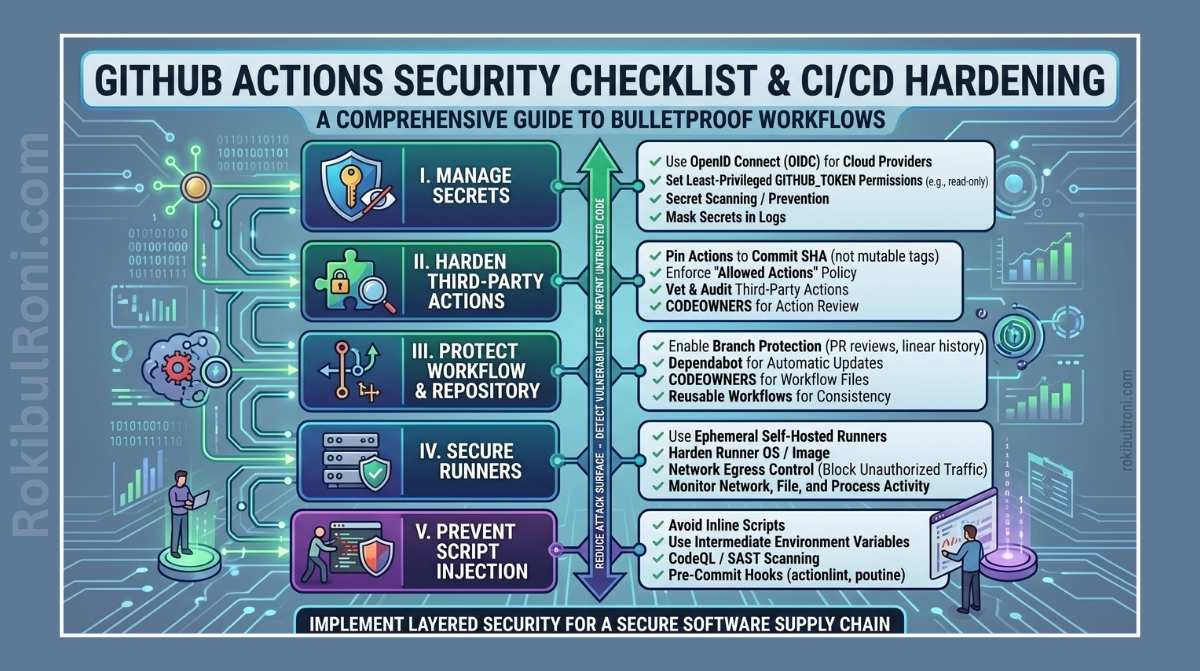
CI/CD pipelines are, in practice, production control planes. A workflow that can push code, publish artifacts, assume cloud roles, or deploy infrastructure is part of your attack surface — full stop. Most teams underestimate this until something goes wrong.
Hardening GitHub Actions isn’t about slowing delivery. It’s about closing avoidable trust gaps before someone exploits them while keeping your release process predictable and fast.
GitHub Actions security checklist
Use this as both a defensive checklist and an operating model for secure workflow governance across your engineering organization.
1) Why CI/CD deserves the same scrutiny as production systems
If you wouldn’t leave a production API exposed without controls, you shouldn’t leave your pipeline exposed either. Here’s why:
- Pipelines can directly modify production code and runtime state
- Build systems regularly hold secrets and deployment credentials
- Workflow changes can bypass runtime protections that your security team spent months implementing
- Third-party actions introduce external supply-chain risk you don’t control
- A misconfigured self-hosted runner can expose your internal network
The real danger is that application-level security controls become meaningless if an attacker can compromise the pipeline upstream. You end up with a perfectly hardened application deployed by a compromised CI system.
2) Core hardening areas — tackle these together, not one at a time
One common mistake teams make is hardening only the most obvious risk (usually secrets) while leaving everything else untouched. These controls work as a system:
- Workflow permissions and token minimization
- Third-party action governance and version pinning
- Branch protection and release gating
- Secrets handling and log redaction discipline
- Pull request trigger safety for untrusted contributions
- Artifact integrity and retention boundaries
- Runner isolation and lifecycle controls
- Dependency and code security scanning built into the pipeline
3) Control reference table — keep this in your governance docs
| Control | Risk Reduced | How to Review | Recommended Setting |
|---|---|---|---|
Workflow permissions block | Token overreach and unintended repo/admin operations | Inspect each workflow for explicit permissions declaration | Default to read and grant only required scopes |
Least-privilege GITHUB_TOKEN | Unauthorized write operations from compromised steps | Check job-level token usage and required API calls | Narrow permissions per job, avoid broad repo write |
| Third-party action trust | Supply-chain compromise from unvetted actions | Inventory external actions and maintain allowlist | Use trusted sources and governance approval process |
| Action version pinning | Uncontrolled behavior changes from moving tags | Search for floating refs (@main, broad tags) | Pin to immutable commit SHA where feasible |
| Branch protection rules | Direct risky changes to protected branches | Review branch settings and bypass permissions | Require PR review, status checks, and restricted force pushes |
| Environment approvals | Unreviewed deployment to sensitive targets | Validate env protection rules and reviewers | Enforce manual approval for prod/stage deployments |
| Secrets handling | Secret exposure through logs and workflow misuse | Review logs, masked values, and secret access boundaries | Scope secrets by environment and minimize availability |
| Pull request trigger safety | Untrusted code execution with privileged context | Review use of PR-related triggers and secret exposure paths | Use safer trigger patterns and strict conditions |
| Artifact exposure controls | Leakage or tampering of build outputs | Review artifact permissions, retention, and download controls | Restrict access and keep retention minimal |
| Self-hosted runner hardening | Lateral movement and persistence risk on runner hosts | Audit network access, isolation model, and cleanup behavior | Isolate runners, ephemeral where possible, minimal outbound scope |
| Dependency/code scanning | Vulnerability drift and hidden risky dependencies | Check workflow coverage and result handling | Run dependency and code scanning in PR + scheduled jobs |
| CodeQL/secret scanning coverage | Missed code and credential risk before merge | Validate enablement across key repositories | Enable by default and triage findings with ownership |
Review this quarterly. CI/CD environments change fast and controls that were solid six months ago may have drifted.
4) Workflow permissions and token hardening
Most preventable CI/CD incidents trace back to one thing: overly broad token permissions. The default GITHUB_TOKEN scope is often wider than any individual job actually needs, and teams rarely think to restrict it.
The fix is straightforward — require an explicit permissions block in every workflow. If a job only reads the repository to run tests, it has no business with write access to packages or deployments.
Key practices:
- Require explicit
permissionsin every workflow file - Scope token rights per job, not globally, wherever possible
- Remove write scopes from build and test jobs entirely
- Keep deployment jobs separate from test jobs with stricter approval paths
- Review reusable workflows carefully — they can inherit and expand permissions in non-obvious ways
| Job Type | Typical Needed Access | Hardening Notes |
|---|---|---|
| Lint/Test | Read repository contents | No write scopes required |
| Build Artifact | Read + artifact publish scope | Avoid repo/admin mutation permissions |
| Release Tagging | Controlled write for release process | Restrict to protected branch and approved context |
| Deployment | Environment-scoped credentials/permissions | Require approval gate and audited actor context |
5) Third-party actions and supply-chain risk
External actions are a genuine convenience — they save time and solve real problems. But each one extends trust to code you don’t control, maintained by people you don’t vet, at versions that can change without warning.
The tj-actions/changed-files incident in March 2025 was a sharp reminder of what this risk looks like in practice. A compromised action with a floating tag reference can silently execute malicious code across every repo using it.
Governance model:
- Maintain an approved action catalog your team actually uses
- Pin action versions to immutable commit SHAs — not tags, not
@main - Require a security review before adding any new external action
- Track action owners, maintenance status, and risk classification
- Periodically audit whether each action is still necessary
Questions to ask before adding any external action:
- Is the source organization trusted, active, and well-maintained?
- Is it pinned to an immutable version?
- Does it request privileged token scopes it doesn’t obviously need?
- Could the same task be done with a native step or an internal action instead?
- Is there a fallback plan if this action gets deprecated or compromised?
6) Branch protection and deployment gating
Pipeline hardening falls apart if your repository governance is weak. Branch protection rules are the foundation everything else sits on.
Minimum controls for protected branches:
- Required reviews before merging to main/default branches
- Required status checks — tests, scans, policy validation — must pass before merge
- Restricted bypass or override permissions (not everyone needs to force-push)
- Signed commit or provenance policy where your risk profile warrants it
- Deployment jobs tied to protected environments with named reviewers
| Stage | Required Controls |
|---|---|
| Development | Automated checks + basic policy validation |
| Staging | Additional security checks + owner review |
| Production | Manual approval + high-confidence status checks + audit logging |
This structure keeps release velocity high while dramatically reducing the blast radius of a mistake or a compromised account.
7) Secrets handling — scope, rotate, and monitor
Treat CI/CD secrets as temporary, scoped assets rather than long-lived credentials you set once and forget. The goal is that compromising one secret does minimal damage.
What to do:
- Use environment-scoped secrets rather than repository-wide secrets wherever possible
- Minimize which jobs can actually access each secret
- Rotate secrets on a schedule and immediately after any incident or suspicious activity
- Avoid threading secrets through intermediate steps that don’t need them
- Regularly review logs for accidental exposure patterns
| Bad Pattern | Better Practice |
|---|---|
| One broad secret reused across all environments | Separate secrets per environment with narrowest possible scope |
| Logging command output without masking review | Use structured logging with masking validation |
| Long-lived cloud credentials stored as secrets | Short-lived OIDC-based federated access whenever the cloud provider supports it |
| Secrets available to every workflow path | Restrict to deployment paths with explicit approvals |
OIDC-based federated identity — supported by AWS, GCP, Azure, and others — eliminates the need to store long-lived credentials in GitHub secrets entirely. If your cloud provider supports it, use it.
8) Pull request trigger safety
PR workflows are a common weak point, especially in open-source or multi-contributor repositories. The problem is that pull_request_target and similar triggers can execute workflow code in a privileged context while also exposing it to changes submitted by untrusted contributors.
Controls that matter:
- Keep privileged steps away from untrusted PR execution contexts
- Maintain strict separation between validation workflows and deployment-capable workflows
- Require conditions before sensitive jobs execute
- Make secrets inaccessible in lower-trust execution paths by default
The core principle: treat contributor-submitted workflow context as lower trust until that code has been reviewed and merged into the main branch.
9) Artifact security and self-hosted runner hardening
These two areas are consistently under-governed in smaller teams, often because they feel less critical than secrets or permissions. But they represent real lateral movement and data leakage risk.
Artifact controls:
- Define retention periods based on sensitivity — don’t keep production build artifacts indefinitely
- Limit who can access and download artifacts, especially from release pipelines
- Validate integrity signals before consuming artifacts in downstream deployment steps
- Clean up stale artifacts from old releases
Self-hosted runner controls:
- Isolate runners from broad internal network access — they should reach only what they need
- Use ephemeral runner patterns whenever practical so each job starts from a clean state
- Apply baseline OS hardening and patch management to runner hosts like any other server
- Restrict which workflows and repositories can target sensitive runner groups
- Enforce cleanup between jobs to prevent residue from one job affecting the next
| Runner Risk | Detection Signal | Mitigation |
|---|---|---|
| Persistent contamination between jobs | Unexpected files or processes after job completion | Ephemeral execution model + cleanup hooks |
| Excessive network reach | Jobs contacting unrelated internal services | Network segmentation and egress restrictions |
| Unauthorized workflow targeting | Sensitive runners used by low-trust workflows | Label restrictions and repo-level access policy |
| Patch lag | Known vulnerable packages on runner images | Image lifecycle management with regular updates |
10) Building a security review process that doesn’t slow shipping
Security should be embedded in normal PR and release operations, not bolted on as a late-stage gate that delays releases and frustrates developers.
How to structure it:
- Define your CI/CD control baseline and assign clear ownership
- Add checklist-based workflow reviews to PR templates — keep them short and focused
- Automate checks for the highest-risk patterns: broad permissions, floating action refs, unsafe triggers
- Reserve manual security review for high-risk workflow changes, not every PR
- Track exceptions with an expiry date and a named owner
- Schedule regular reviews of your most critical workflows regardless of recent changes
| Change Type | Required Reviewer |
|---|---|
| Minor test step update | Repository maintainer |
| New third-party action | Security + maintainer |
| Permission expansion | Security + platform owner |
| Production deployment logic change | Security + release owner + team lead |
| Runner target change | Platform/security owner |
The matrix keeps reviews proportional to actual risk. Not every change needs a security sign-off — just the ones that genuinely matter.
11) Security and developer collaboration that actually works
Hardening programs that treat security as a blocking function don’t scale. The ones that work treat developers as partners who want to ship safely, not adversaries trying to bypass controls.
Collaboration practices that scale:
- Publish a “secure workflow starter” template that developers can copy rather than building from scratch
- Offer an approved action catalog for common CI/CD tasks so developers aren’t tempted to find their own alternatives
- Use advisory mode on new controls first, then gradually enforce once teams understand the intent
- Share a monthly pipeline risk dashboard at the team level — visibility builds buy-in
- Run brief incident retrospectives focused on control improvements rather than blame
The roles in this model are distinct: security provides control intent and risk context; developers provide workflow feasibility and release impact insight; platform teams provide the automation and policy enforcement path. All three are necessary.
12) Common mistakes in GitHub Actions hardening
These patterns show up repeatedly in pipeline security reviews:
- Default token permissions left broad across all jobs
- Unpinned third-party actions in production workflows — the most common supply-chain risk
- Secrets exposed through debug logging or unsafe step composition
- Untrusted PR paths reaching privileged execution contexts
- Production deployments running without environment approval gates
- Self-hosted runners with excessive persistent trust and no ephemeral isolation
- No clear ownership for workflow security reviews, so nothing gets reviewed
Anti-drift guardrails to put in place:
- Block merges that contain high-risk workflow anti-patterns
- Require explicit permission blocks in all new workflows via repository policy or linting
- Enforce action pinning in protected repositories
- Run a quarterly workflow governance audit with named accountable owners
13) 30-day hardening roadmap
If you’re starting from scratch or need to demonstrate rapid progress, this gives you a structured path to meaningful security improvement in one month.
Week 1: Visibility and baseline inventory
Before you can fix anything, you need to know what you have. Inventory all workflows, tokens, external actions, runners, and environments. Classify workflows by risk level — test, build, deploy, admin. Identify your biggest critical gaps: broad permissions, floating action refs, unsafe PR triggers.
Output: CI/CD risk register v1
Week 2: Fix the highest-risk controls
Add explicit permissions to your most critical workflows. Pin high-risk third-party actions to immutable SHAs. Tighten environment protections on all production deployment paths.
Output: critical hardening change set
Week 3: Secrets and runner governance
Scope secrets by environment and job necessity. Review your self-hosted runner segmentation and who can target which runner groups. Implement retention and visibility controls for build artifacts.
Output: secrets/runner governance update report
Week 4: Policy automation and operating cadence
Add automated policy checks for risky workflow patterns so humans don’t have to catch everything manually. Define your recurring review schedule with named owners. Publish a secure workflow template and team guidance document.
Output: 30-day hardening completion report + next-quarter roadmap
14) Metrics to demonstrate hardening progress
Hardening programs need evidence of progress to sustain support and budget. These metrics tell a clear story:
| Metric | Why It Matters | Target Direction |
|---|---|---|
| % workflows with explicit permissions declared | Indicates least-privilege maturity across the pipeline | Up |
| % external actions pinned to immutable SHAs | Directly measures supply-chain control strength | Up |
| Count of workflows with broad write token scope | Overprivilege indicator — should shrink over time | Down |
| Secret exposure incidents in logs | Operational control effectiveness signal | Down |
| % production deploy workflows with approval gates | Release governance coverage | Up |
| Mean time to review high-risk workflow changes | Operational efficiency — are reviews happening promptly? | Down |
A secure GitHub Actions program is an engineering system, not a one-time checklist. Explicit permissions, trusted dependencies, scoped secrets, controlled runners, and a review process that keeps pace with your shipping velocity — these compound over time into a meaningful security posture.
CI/CD security operations worksheet
| Workstream | Owner | First Action | Validation Signal |
|---|---|---|---|
| Workflow permission hygiene | Platform security | Require explicit permission blocks in all workflows | Reduced overprivileged token usage in audits |
| Third-party action governance | DevSecOps lead | Maintain approved action catalog with pinning policy | Fewer risky or unpinned action references |
| Runner hardening | Infrastructure owner | Segment and restrict runner groups by trust level | Lower runner misuse and lateral-risk exposure |
| Secrets management | Security + dev leads | Scope secrets by environment and job necessity | Reduced secret exposure in logs and incidents |
Weekly operational checklist
- Review new workflow changes for permission expansion
- Audit unpinned third-party actions in protected repositories
- Validate environment approval flows for production deployment jobs
- Track unresolved CI/CD security findings by named owner
Workflow governance handoff pack
When you need to hand off CI/CD security governance to another team or present status to leadership, these artifacts cover what matters:
| Artifact | Minimum Content | Consumer |
|---|---|---|
| Workflow risk register | Workflow ID, risk category, owner, due date | Platform + security leadership |
| Policy exceptions | Justification, expiry date, compensating controls | Governance/risk owners |
| Runner posture report | Access model, patch status, isolation controls | Infra + security teams |
| Monthly scorecard | Permission hygiene, pinning status, secrets incidents | Engineering leadership |
Quality checks before handoff:
- Are high-risk workflow changes reviewed before they merge?
- Are policy exceptions time-bound and actively monitored?
- Are production deployment controls consistently enforced?
90-day CI/CD hardening cadence
Days 1–30
Establish your baseline. Inventory all workflows, runners, and third-party actions. Eliminate the highest-risk permission and pinning gaps. Stand up a monthly governance scorecard so progress is visible.
Days 31–60
Harden runner isolation and access boundaries. Improve secret lifecycle controls and implement leak monitoring. Add automated policy checks to pull request pipelines so enforcement happens at scale.
Days 61–90
Audit for control drift and unresolved exceptions that have accumulated. Tune enforcement thresholds to reduce unnecessary developer friction. Publish your next-quarter CI/CD risk reduction roadmap with specific targets.
| KPI | Why It Matters |
|---|---|
| Workflows with explicit least-privilege permissions | Core access control maturity signal |
| Pinned third-party action coverage | Supply-chain governance indicator |
| Secrets exposure incidents | Operational control effectiveness metric |
| High-risk workflow review completion | Governance discipline measure |
CI/CD security gets better when engineering velocity and control maturity are treated as complementary goals rather than opposing forces.
Pipeline controls that stay enforceable as teams grow
The hardest part of CI/CD security isn’t the initial implementation — it’s keeping controls effective as repositories multiply, teams change, and workflows evolve. Here’s what needs to be in place to make that work:
Mandatory baseline controls
| Control | Enforcement approach |
|---|---|
| Protected branches | Require PRs and reviews for the default branch, no exceptions |
| Least-privilege tokens | Fine-grained permissions per workflow, not global defaults |
| Trusted actions | Pin versions; restrict untrusted third-party actions via org policy |
| Secret handling | No plaintext secrets in workflow files; rotate on schedule and after incidents |
| Build provenance | Generate SLSA attestations for release-critical artifacts |
Per-repository workflow review checklist
- Does this workflow run on PRs from forks? If yes, are the risky steps isolated from secrets and write access?
- Are permissions explicitly declared at the job or workflow scope?
- Are third-party actions pinned to immutable commit SHAs?
- Are release pipeline artifacts signed or checksummed?
- Is there a named owner in CODEOWNERS who reviews CI changes?
Change management for pipeline code
Treat .github/workflows/* as sensitive production code. Require review from a small, named group. Maintain a “known-good” template for common workflow patterns that teams can copy rather than inventing their own. Periodically review your highest-risk repositories — release repos, infrastructure automation, admin tooling — even when nothing has recently changed.
| Metric | Why |
|---|---|
| Workflows with explicit permissions | Reduces accidental privilege escalation |
| Unpinned third-party actions | Directly tracks supply-chain exposure |
| Time-to-rotate secrets after incident | Tests whether your operational response actually works |
This is what professional GitHub Actions security looks like: enforceable guardrails, controlled change management, and measurable coverage that you can show to leadership and auditors.