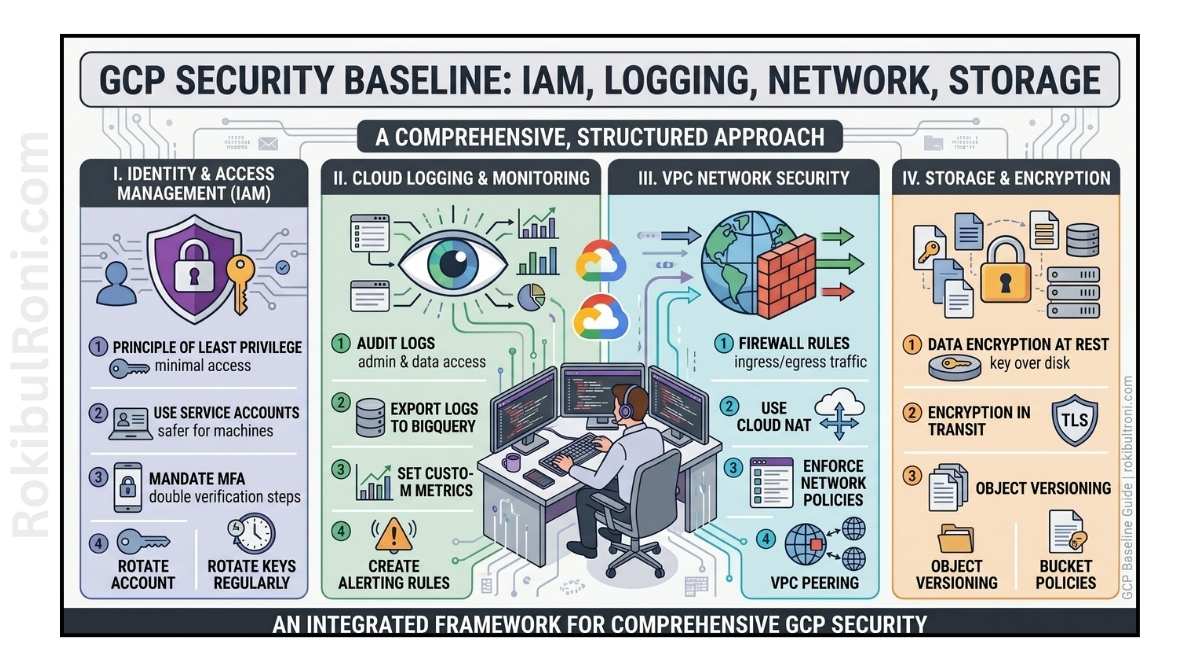
GCP environments tend to become difficult to secure not because of sophisticated attacks, but because growth happens faster than governance. Teams spin up projects, create service accounts, open firewall rules, and provision storage buckets quickly — and then try to retrofit security controls afterward. The result is a predictable combination of privilege sprawl, incomplete visibility, and exposure that nobody intended.
A security baseline solves this by defining the minimum controls every project must meet before scaling further. It’s not a final architecture. It’s the minimum safe operating standard.
GCP security baseline
Use this guide as a practical implementation framework for your internal cloud hardening program.
1) Why a baseline needs to exist before cloud scale, not after
Waiting until a GCP environment is large and complex to define baseline controls creates a much harder problem. Here’s what you’re preventing by establishing the baseline early:
- Project sprawl without clear ownership or consistent tagging
- Broad IAM grants that made sense at the time and then never got narrowed
- Audit logs that weren’t enabled before an incident that required them
- Network exposure that accumulated one firewall rule at a time
- Inconsistent control expectations that engineering teams can’t meet because nobody defined them
The baseline doesn’t constrain engineering. It creates a floor that everyone can operate above reliably.
2) The domains you need to standardize first
Some teams try to build a comprehensive GCP security program all at once and end up with a long backlog of partially-implemented controls. A more effective approach is to establish these domains in roughly this order — identity, logging, and network before broad workload rollout:
- Organization and project hierarchy design
- IAM roles, groups, and service account governance
- MFA and identity assurance for privileged users
- Cloud Audit Logs configuration and retention strategy
- VPC firewall rules and network segmentation
- Cloud Storage exposure and access control
- Public exposure detection and remediation workflows
- Secret handling and key management hygiene
- Compute and container hardening essentials
- Billing alerts and cost anomaly monitoring as a security signal
If you reverse that order and deploy workloads before identity and logging controls are solid, risk accumulates faster than governance can catch it.
3) GCP baseline checklist — use this as a recurring governance artifact
| Baseline Control Area | Minimum Standard | Validation Method | Owner |
|---|---|---|---|
| Organization Structure | Projects grouped by environment and business function with clear ownership | Org/project inventory review | Cloud platform owner |
| IAM Role Design | Least-privilege roles; no unnecessary Owner-level assignments | IAM bindings audit | IAM/security team |
| Service Accounts | Dedicated service accounts per workload with scoped permissions | Service account inventory + policy review | Platform engineering |
| MFA Enforcement | MFA required for all privileged access paths | Identity policy verification | Identity admin |
| Cloud Audit Logs | Admin activity and data-access logs enabled at appropriate scope | Logging policy and sink checks | Security operations |
| VPC Firewall Rules | Ingress and egress aligned to approved services only | Firewall rule audit + change review | Network/cloud ops |
| Cloud Storage Security | Buckets private by default with documented explicit exceptions | Bucket ACL/IAM policy scan | Data/platform owner |
| Public Exposure Control | External endpoints inventoried and reviewed with named owners | Exposure report + owner confirmation | Cloud security |
| Secrets Management | No secrets in code or environment variables where avoidable; managed storage used | CI scan + config review | DevSecOps |
| Compute Hardening | Baseline images, patch process, and metadata protections in place | Image/policy compliance checks | Compute owner |
| Container Security | Workload identity, least privilege, and image scanning controls active | Cluster and CI policy checks | Kubernetes/platform team |
| Billing and Alerting | Budget alerts and anomaly monitoring enabled across projects | Billing config review | FinOps + security |
This table belongs in your governance review cadence, not just as onboarding documentation.
4) Practical risk prioritization — not all gaps are equal
When you’re looking at a gap register with dozens of findings, you need a way to decide what to fix first. Prioritize by the combination of exposure, privilege level, and potential business impact.
Highest-priority risk categories
- Public exposure with weak or absent access controls
- Privileged identities with broad or unmanaged access
- Missing or incomplete audit logging before it’s needed
- Unmanaged service account keys and stale credentials sitting in automation
- Overly permissive firewall rules that opened for a reason and never closed
| Risk Pattern | Likelihood | Business Impact | Priority |
|---|---|---|---|
| Public bucket with sensitive data potential | High | High | Critical |
| Excessive Owner role usage across projects | Medium-High | High | High |
| Missing audit logs for privileged actions | Medium | High | High |
| Stale service account keys in automation | Medium | Medium-High | High |
| Broad firewall ingress on non-public services | Medium | High | High |
| Project naming/ownership inconsistency | High | Medium | Medium |
If two or more high-priority risks coexist in a production environment, treat baseline remediation as an urgent program with dedicated resources — not a background task competing with feature work.
5) Tooling workflow for baseline assessments
The right approach is to use tooling for visibility and repeatability, then validate manually before making significant changes. Automated tools surface findings quickly; human review ensures you understand the context before acting.
| Tool / Platform | Practical Use in Baseline Work |
|---|---|
gcloud CLI | Controlled inventory, policy inspection, and validation commands |
| Security Command Center | Centralized misconfiguration and exposure signal aggregation across your org |
| Cloud Asset Inventory | Asset ownership, IAM bindings, and configuration relationship mapping |
| Cloud Logging | Audit event review and control verification |
| Cloud Monitoring | Operational signal and alerting configuration |
| SIEM export pipeline | Cross-domain correlation and long-term incident analysis |
Assessment sequence that works in practice:
- Pull your asset and IAM inventory using Cloud Asset Inventory or
gcloud - Compare current state against your baseline checklist controls
- Score gaps by risk priority using the matrix above
- Validate findings with actual service owners before assuming the finding is a problem
- Plan phased remediation with rollback readiness for changes that could affect production
Step 4 matters more than it sounds. Context from service owners frequently changes the priority or the remediation approach.
6) IAM baseline specifics — this is where drift causes the most long-term damage
IAM drift is typically the largest sustained cloud security risk because it’s incremental and quiet. Privileges get added for legitimate reasons and rarely get removed. Over time, the gap between what people need and what they have grows into serious exposure.
IAM hardening controls:
- Stop using primitive roles (
Owner, broadEditorbindings) as a convenience shortcut - Prefer group-based access over direct user bindings — it’s easier to manage and audit
- Scope role assignments at the lowest practical resource level (project or resource, not organization where avoidable)
- Maintain clear separation between human admin identities and workload service accounts
- Review service account key age and usage; rotate or remove stale keys
- Enforce an approval process for any privileged role grants
| IAM Check | What to Look For | Action |
|---|---|---|
| Primitive role overuse | Excess Owner or broad Editor bindings across projects | Replace with scoped predefined or custom roles |
| Direct user privilege grants | Individual high-privilege bindings to specific users | Migrate to managed groups with an approval workflow |
| Service account sprawl | Unclear ownership and ambiguous role purpose | Tag ownership and progressively reduce role scope |
| Key hygiene issues | Old or unused service account keys | Rotate and revoke; prefer Workload Identity Federation for keyless patterns |
Workload Identity Federation, which lets services authenticate using short-lived tokens instead of long-lived keys, is now stable and well-supported across major CI/CD systems and cloud providers. If your automation still relies on service account key files, migrating to WIF is a meaningful security improvement.
7) Logging baseline — without reliable logs, incident response is guesswork
The value of audit logs is only apparent when you need them during an incident. The time to configure them is before something happens.
Logging baseline controls:
- Enable required Cloud Audit Logs at the appropriate scope — org, folder, or project — for Admin Activity and Data Access events
- Route critical log events to durable, separate storage and/or a SIEM via log sinks
- Define retention periods that align with your policy and regulatory requirements
- Protect log integrity with access controls and separation of duties between teams that generate logs and those who could modify them
- Monitor for logging pipeline failures and dropped events — a silent logging failure is worse than a noisy one
| Signal | Interpretation | Follow-up |
|---|---|---|
| Sudden drop in auth or admin events | Ingestion or configuration drift | Validate sinks and logging policies immediately |
| Missing events for privileged operations | Coverage gap in audit configuration | Correct log type enablement and re-verify |
| High delay between event time and availability | Pipeline latency issue | Tune routing and processing path |
One practical tip: create an alert on your log volume metrics. A drop to zero or near-zero on a normally busy project is a strong indicator of a sink or configuration problem.
8) Network and storage baseline — most cloud exposure comes from misconfiguration, not intrusion
The majority of public cloud exposure incidents don’t involve sophisticated attacks. They involve firewall rules that were too broad, buckets that were accidentally made public, or defaults that nobody changed.
Network baseline essentials:
- Default-deny ingress where practical — allow lists beat deny lists for security posture
- Restrict management interfaces and administrative access to approved network paths
- Segment workloads by environment and trust level using separate VPCs or subnets
- Apply egress controls to sensitive workloads to prevent unexpected data exfiltration paths
- Document every exception with a named owner and an expiry date — undocumented exceptions become permanent
Storage baseline essentials:
- Private-by-default bucket policy enforced at the organization level through Organization Policy constraints
- All public access exceptions require explicit approval and documentation
- Bucket and object access governed by least-privilege IAM, not legacy ACLs where avoidable
- Monitoring configured for policy or ACL changes that could increase exposure
- Access and retention controls aligned to data classification
| Area | High-Risk Pattern | Baseline Expectation |
|---|---|---|
| VPC Firewall | Broad internet ingress rules to internal services | Explicit allow rules only for required sources and services |
| Admin Access Paths | Direct broad admin access from the public internet | Controlled access with strict identity verification and network controls |
| Cloud Storage | Public bucket access enabled by default or accidentally | Public access disabled at org policy level unless documented exception |
| Inter-project Connectivity | Untracked or undocumented trust paths between projects | Documented and periodically reviewed connectivity policies |
9) Managing exceptions without letting them accumulate into hidden risk
Some deviations from baseline controls are genuinely necessary. The problem isn’t exceptions — it’s untracked exceptions that nobody remembers approved or why they exist.
Every exception record needs:
- The specific control being bypassed
- A clear business justification for why the deviation is necessary
- A named risk acceptance owner who is accountable
- Compensating controls that reduce the risk of the deviation
- An expiration date and review schedule
- Validation evidence showing the compensating controls are working
| Exception Attribute | Required Value |
|---|---|
| Approval | Named accountable manager + security reviewer |
| Duration | Time-bounded with an explicit review date |
| Compensating Control | Documented technical or operational mitigation |
| Visibility | Included in monthly governance reporting |
| Closure Criteria | Defined condition that would allow the exception to be removed |
No exception should be permanent without periodic executive-level review. If something has been “temporary” for two years, it needs a hard decision: fix it, accept it formally, or escalate.
10) Common GCP baseline mistakes to avoid
These show up consistently in GCP security assessments:
- Project sprawl without naming conventions or ownership assignment
- Owner-level access granted for convenience and never scoped down
- Buckets accidentally made public through IAM changes or default setting changes
- Missing log retention and no validation that log pipelines are actually working
- Service account key files left active long after they’re needed
- Firewall rules broadened during an incident or change window and never reverted afterward
- Baseline documented once in a wiki and then never operationalized or revisited
Anti-drift guardrails that actually help:
- Monthly baseline conformance review with a fixed agenda and named participants
- Change-control integration for IAM, network, and storage policy changes
- Automated compliance checks in CI/CD pipelines where infrastructure is code
- Quarterly exception review to close or formally re-accept accumulating exceptions
11) 30-day GCP hardening roadmap
This roadmap gives you a structured path to meaningful baseline coverage in one month without requiring a team to drop everything else.
Week 1: Establish visibility and ownership
You can’t fix what you can’t see. Inventory all projects, identities, service accounts, and storage buckets. Tag owners for critical workloads and classify them by risk level. Identify your top public exposure and privilege risks so Week 2 is focused.
Output: baseline gap register v1
Week 2: Address critical identity and exposure gaps
Reduce the highest-risk IAM grants — prioritize Owner-level bindings and direct user assignments to sensitive resources. Lock down any public storage exposures immediately. Tighten the most dangerous firewall rules that are providing no legitimate business value.
Output: critical-risk remediation change set
Week 3: Logging, monitoring, and detection alignment
Validate that audit log coverage actually exists where you think it does. Check that log sinks are functioning and routing to the right destinations. Integrate high-value signals into SIEM workflows. Set up alerts for privileged changes and exposure drift.
Output: logging assurance and detection baseline report
Week 4: Governance hardening and sustainability
Implement an exception register with a defined review cadence. Finalize baseline policy documentation in a format engineering teams can actually use. Present status, residual risk, and next-quarter priorities to leadership.
Output: 30-day hardening completion report + roadmap
12) Metrics that indicate baseline maturity
| Metric | Why It Matters | Target Direction |
|---|---|---|
| % projects with defined owner tags | Foundation of all governance — you can’t manage what nobody owns | Up |
| % privileged identities with MFA enforced | Identity assurance maturity for high-impact access | Up |
| Count of public-exposure exceptions with documentation | Exposure risk and governance discipline combined | Down (while documented count stays up) |
| % service accounts using Workload Identity Federation or recent key rotation | Credential hygiene quality | Up |
| Audit log coverage across critical projects | Incident readiness — can you investigate when something happens? | Up |
| Mean time to remediate critical baseline gaps | Program execution speed and team responsiveness | Down |
A strong GCP baseline is not a checkbox activity. It’s an operating rhythm: consistent control definitions, clear ownership, evidence-backed validation, and recurring reviews that keep cloud growth within safe boundaries.
Baseline operations worksheet for GCP teams
| Workstream | Owner | First Action | Validation Signal |
|---|---|---|---|
| Project governance | Cloud platform lead | Enforce naming and owner standards for all new and existing projects | Fewer orphaned or ambiguous projects in monthly audit |
| IAM hygiene | Identity admin | Audit primitive role usage and stale service accounts with keys | Measurable reduction in broad-access assignments |
| Logging assurance | Security operations | Validate audit log coverage and verify log sink integrity | Reliable event visibility for critical administrative actions |
| Exposure control | Cloud security engineer | Review public endpoints and bucket exposures on a weekly cadence | Faster closure of accidental exposure findings |
Governance checklist — run this monthly
- Confirm owner mapping for all new projects and critical resources added since last review
- Validate exception register: check for expired approvals and items past their review date
- Review recent firewall and storage changes for unintended drift
- Track all unresolved high-priority baseline gaps with assigned owners and due dates
Control validation and handoff pack
When handing off GCP security governance or presenting to leadership or auditors, these artifacts cover what they’ll ask for:
| Artifact | Minimum Content | Consumer |
|---|---|---|
| Baseline gap register | Control gap, risk level, assigned owner, due date | Security + platform leads |
| Validation evidence | Commands, screenshots, or log references per control | Audit and governance teams |
| Exception record | Justification, compensating controls, expiry date | Risk owners |
| Quarterly status brief | Progress trends, metric movement, and unresolved risk clusters | Leadership stakeholders |
Quality checks before any handoff:
- Are all critical baseline gaps assigned with realistic deadlines and accountable owners?
- Can each claimed control be validated with actual evidence rather than assumption?
- Is the exception list shrinking over time, or accumulating without closure?
90-day baseline execution cadence
Days 1–30
Reconcile your project inventory and confirm owner mapping. Prioritize and close the top critical exposure and IAM gaps identified in Week 1 of the 30-day roadmap. Validate that required logging controls are active across your highest-value projects.
Days 31–60
Harden firewall and storage controls in remaining high-risk projects that weren’t addressed in the first month. Improve service account governance — reduce key usage in favor of Workload Identity Federation where possible. Build recurring compliance checks into your infrastructure change workflows.
Days 61–90
Run your first quarterly baseline conformance review. Measure actual risk reduction against your opening baseline gap register. Publish your next-cycle hardening roadmap with specific, measurable targets.
| KPI | Why It Matters |
|---|---|
| Projects with complete owner metadata | Governance completeness — foundational to all other controls |
| Critical baseline gaps closed | Core hardening progress metric |
| Exception count with valid and current expiry dates | Exception control maturity |
| Audit log coverage on critical projects | Incident readiness quality |
Baseline maturity grows when teams combine technical controls, governance ownership, and recurring validation into a stable operating model rather than treating each as a separate one-time effort.
Baseline verification and drift management
A baseline is only meaningful if you continuously verify it holds. The fastest way to lose GCP security posture is to treat baseline work as a completed project.
Drift signals to monitor actively:
| Area | Drift Signal | Why It Matters |
|---|---|---|
| IAM | New high-privilege bindings or broad primitive role assignments | Expands blast radius quickly and quietly |
| Logging | Disabled sinks, audit logs turned off, reduced retention settings | Removes your investigation capability exactly when you need it |
| Network | New public IP addresses or expanded firewall allow rules | Increases attack surface incrementally |
| Storage | Buckets becoming public or IAM policies weakened | Creates data leakage risk that may not be immediately visible |
Baseline evidence pack for audits and reviews:
- IAM review summary covering principals, privileged roles, and documented exceptions
- Logging configuration snapshot with audit log settings, active sinks, and retention policies
- Network exposure summary covering public services and firewall rule highlights
- Storage posture summary covering public access control settings and encryption defaults
Change management standards that prevent drift:
- Any change introducing public exposure or elevated privileges requires explicit named-owner approval before implementation
- Exceptions are time-boxed with a hard expiry date and a linked follow-up ticket
- Baseline controls are reviewed on a fixed cadence — monthly for critical projects, quarterly for everything else
| KPI | Target Direction |
|---|---|
| Privileged principals without documented justification | Down to zero |
| Logging coverage for critical projects | Up to 100% |
| Publicly exposed services without a documented owner | Down to zero |
| Baseline exceptions past their expiry date | Down to zero |
This is what professional GCP baseline security looks like: verifiable controls, measurable posture, and strict handling of drift and exceptions so the baseline stays meaningful as your environment grows.