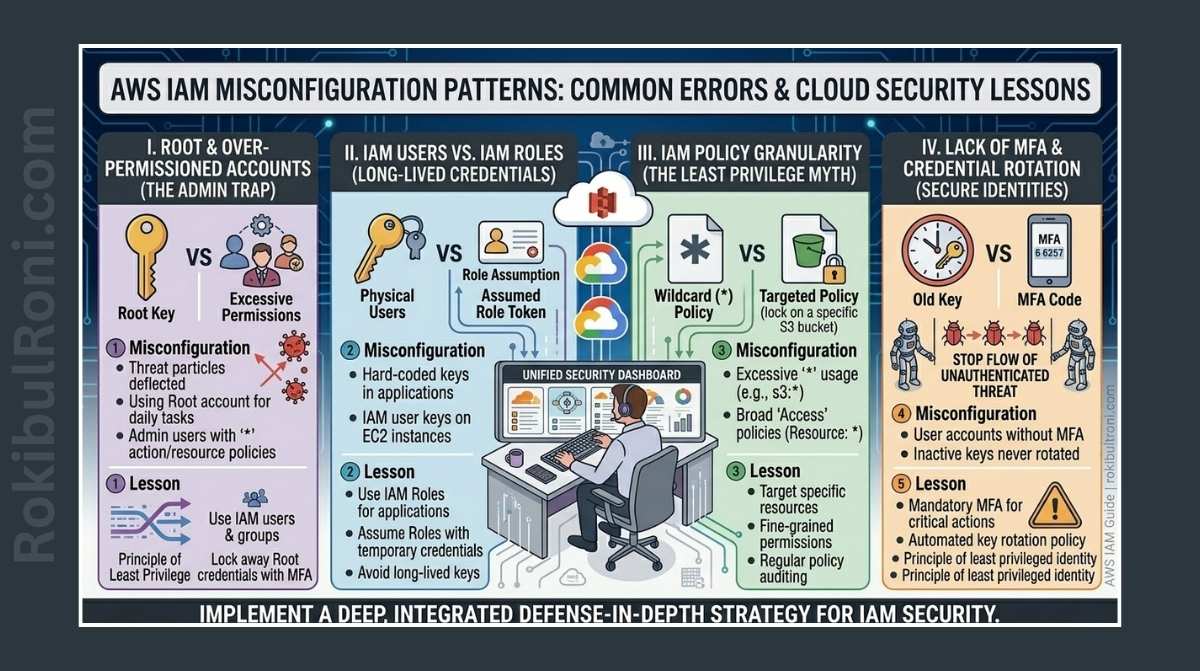
Here’s something that surprises a lot of teams when they first dig into a cloud security incident: the root cause is almost never a network problem. It’s an identity problem. Overpermissioned roles, stale credentials sitting around, trust policies with too-wide a blast radius — these are the things that actually let attackers move laterally and escalate once they’re inside.
IAM is the real perimeter in cloud environments. It controls who can call which APIs, which services can assume which roles, and how far a compromised identity can actually reach. If your identity posture is weak, hardening compute and network layers gets you surprisingly little protection.
This guide walks through how to think about IAM security practically — not from an attacker’s perspective, but from the perspective of someone who needs to clean things up without breaking production.
AWS IAM Misconfiguration Patterns
Use this as a defensive review framework for internal cloud security assessments and hardening projects.
1) Why IAM Is the Modern Cloud Perimeter
Most cloud breaches follow a familiar path: initial access through a phishing email or exposed credential, then lateral movement and privilege escalation through misconfigured identities. The attacker doesn’t need to punch through your firewall. They just need a role with too many permissions, or a trust policy that lets them assume something they shouldn’t.
A few patterns make this worse than it needs to be:
- API-level access is the actual control plane — not VPC boundaries
- Misconfigured service-to-service trust creates lateral movement risk that’s hard to detect
- Long-lived access keys dramatically extend the window of damage from a credential leak
- IAM debt compounds fast — each new workload tends to inherit overly broad permissions from whatever was there before
The earlier you can build a clean identity foundation, the cheaper it is to maintain.
2) Common IAM Misconfiguration Patterns and Risk
These are the misconfigurations that come up most often in cloud security reviews. Some are well-known, but they’re well-known because they’re genuinely common — even in mature environments.
| Misconfiguration | Risk | How to Detect | Remediation |
|---|---|---|---|
| Overly broad IAM policies | Unnecessary access to sensitive APIs and resources | Identify policies with large action or resource scope | Reduce permissions to task-specific actions with scoped resources |
Wildcard permissions (*) | Privilege expansion beyond intended use | Query for wildcard Action or Resource in attached policies | Replace with explicit allowlists and condition keys |
| Stale users and unused principals | Persistent dormant access paths | Compare last-used timestamps against ownership records | Disable, review, and remove unused identities |
| Long-lived access keys | Extended window for credential theft and replay attacks | Audit key age and usage patterns | Rotate keys and shift to temporary credentials via IAM roles |
| Weak role trust policies | Unintended role assumption by unexpected principals | Review trust relationships and principal scope | Restrict trust policy principals and add condition checks |
| Missing MFA for sensitive access | Higher credential abuse risk on privileged paths | Check MFA enforcement on privileged console users | Enforce MFA conditions on high-risk roles and break-glass paths |
| Excessive admin role spread | Elevated blast radius across accounts if any admin is compromised | Inventory AdministratorAccess and equivalent custom policies | Introduce a tiered admin model with approval gating |
| Poor service account separation | Automation abuse and privilege confusion across workloads | Map workload identities to actual responsibilities | Split service roles by function and environment |
| Unmanaged cross-account access | Hidden trust pathways and governance gaps | Review external principals in trust policies and org boundaries | Govern cross-account roles with ownership tags, conditions, and review cycles |
Treat this table as a recurring control review, not a migration checklist you tick off once.
3) Safe IAM Review Workflow — Read-Only First
The instinct when you find IAM problems is to start fixing immediately. Resist that. Jumping straight to changes without understanding the full picture is one of the most reliable ways to cause a production outage.
A sound IAM assessment starts with observation: build an inventory, understand ownership, analyze what permissions actually do, then prioritize changes by risk before touching anything.
Read-Only Review Sequence
- Build a full identity inventory — users, groups, roles, policies, and service-linked roles
- Map ownership to each identity: which team owns it, which application uses it, what environment it lives in
- Analyze attached and inline policies for excess permission scope
- Review trust policies to understand role assumption boundaries
- Check credential hygiene — key age, MFA posture, inactive principals
- Validate cross-account and federated access paths
- Prioritize remediation by exposure level and business impact
Review Output Structure
| Output | Purpose |
|---|---|
| Identity inventory map | Understand who and what can access which resources |
| Permission risk register | Prioritized list of high-risk permission patterns |
| Trust relationship map | Visualize assumption pathways across accounts and services |
| Remediation backlog | Assignable tasks with owner and target date |
Collect evidence first, then change deliberately with rollback plans ready.
4) Practical Policy Analysis Principles
Policy tuning is where teams most often overcorrect. Going too aggressive causes service outages, which creates pressure to roll back everything — and you end up worse off than when you started. The goal is least privilege that actually sticks, not least privilege that gets reverted at 2 AM.
Policy Review Checks
- Remove actions tied to workflows that no longer exist
- Scope
Resourcevalues to specific ARNs wherever technically possible - Add condition keys to provide stronger context enforcement (source IP, MFA, service principal)
- Separate human admin permissions from workload automation permissions
- Avoid embedding broad permissions in shared base roles used across unrelated services
Questions That Surface the Real Risk
- Which permissions are rarely used but would be catastrophic if abused?
- Which roles are shared across workloads that have no business relationship with each other?
- Which policies include broad write or delete actions in production accounts?
- Which trust policies permit assumption by external accounts that weren’t explicitly approved?
5) Logging and Monitoring for IAM Risk Visibility
Hardening IAM without improving detection is incomplete. You need to know when something unexpected happens — a new admin role gets created, an access key spikes in usage at 3 AM, or an unusual cross-account assumption shows up in CloudTrail.
Core Monitoring Components
- AWS CloudTrail for IAM and control-plane event visibility — this should be enabled in every account with log file integrity validation turned on
- Amazon GuardDuty for detecting suspicious access behavior, including credential exfiltration patterns and anomalous API calls
- AWS Config for tracking configuration drift and policy compliance over time
- SIEM integration for correlating identity events with endpoint, network, and application telemetry
IAM Monitoring Reference
| Control | What to Monitor | Practical Signal |
|---|---|---|
| Identity Lifecycle | User and role creation, permission changes | Unexpected privilege grants outside change windows |
| Credential Hygiene | Key creation, rotation, and usage patterns | Stale keys with recent usage spikes |
| Trust Boundaries | Role assumption across accounts | New or unusual cross-account AssumeRole events |
| Privilege Escalation | Policy attachment or inline edits on privileged principals | Rapid permission expansion on sensitive roles |
| Detection Coverage | Alert fidelity and triage outcomes | Repeated false positives or missed escalation events |
Log retention and normalization matter as much as your alert rules. Alerts are only as good as the data underneath them.
6) How IAM Mistakes Affect Core AWS Services
IAM misconfigurations don’t affect all services equally. Understanding the service-specific impact helps engineering teams prioritize where to focus first.
| Service Area | IAM Weakness Pattern | Potential Business Effect |
|---|---|---|
| CI/CD Pipelines | Overprivileged deployment roles | Unauthorized release changes or unintended environment drift |
| S3 Data Stores | Broad read or write policies | Data exposure, integrity loss, or accidental deletion at scale |
| EC2 Workloads | Weak instance profile controls | Host-level actions beyond the workload’s intended scope |
| Lambda Functions | Shared high-privilege execution roles | Function misuse and cross-service access spread |
| Kubernetes (EKS) | Overbroad IAM-to-workload mappings | Namespace boundary weakening and unintended secret access |
When you’re writing remediation findings, mapping impact to specific services makes it much easier for engineering teams to prioritize.
7) Least-Privilege Rollout Strategy That Teams Can Actually Sustain
The failure mode for least-privilege initiatives is almost always the same: a one-time policy rewrite with no operating model. The permissions get tightened, something breaks three weeks later, pressure mounts to loosen them again, and you’re back where you started.
Sustainable privilege reduction requires a phased approach with clear ownership at every stage.
Phased Rollout Model
- Discovery — Inventory identities, permissions, and owners. Build your baseline.
- Risk Reduction — Remove obvious broad grants and stale identities that have low disruption risk.
- Policy Refinement — Tighten permissions by role purpose and environment, testing in non-production first.
- Guardrail Integration — Add IAM policy checks into CI/CD pipelines and infrastructure-as-code workflows.
- Continuous Review — Reassess access patterns on a defined monthly or quarterly cadence.
Least-Privilege Governance Table
| Governance Control | Frequency | Owner |
|---|---|---|
| Privileged role review | Monthly | Cloud security lead |
| Stale identity cleanup | Monthly | IAM operations owner |
| Cross-account trust audit | Quarterly | Cloud platform team |
| Policy drift and compliance review | Weekly or bi-weekly | DevSecOps and platform engineering |
| Break-glass access test | Quarterly | Security operations |
8) Common Mistakes During IAM Remediation
Even teams with good intentions make these mistakes. Most of them are avoidable with a bit of sequence discipline.
- Removing permissions without dependency mapping first — this is the most common cause of remediation-induced outages
- Converting wildcards too aggressively without testing each role in isolation
- Leaving cross-account trust relationships undocumented after changes
- Enforcing MFA inconsistently, so some privileged paths are protected and others aren’t
- Keeping “temporary” admin roles permanently because no one wants to own the cleanup
- Assigning no one to policy maintenance, so permissions drift back toward broad over time
- Treating IAM review as an annual audit activity rather than an ongoing practice
Practical Anti-Pattern Guardrails
- Every permission change must have a documented owner and a rollback plan
- Every trust policy change must include an impact assessment
- Every admin-equivalent role requires written business justification
- Every remediation item needs retest evidence before it can be closed
9) AWS IAM Review Checklist (Reusable)
| Review Area | Checklist Item | Done |
|---|---|---|
| Identity Inventory | Users, roles, groups, and policies inventoried with owners | ☐ |
| Privilege Scope | Wildcards and broad grants identified and prioritized | ☐ |
| Credential Security | MFA posture and access key hygiene reviewed | ☐ |
| Trust Policies | Cross-account and federated trust paths validated | ☐ |
| Service Roles | Workload roles separated by purpose and environment | ☐ |
| Monitoring | CloudTrail, Config, and GuardDuty signals reviewed | ☐ |
| SIEM Correlation | IAM events integrated and triaged with context | ☐ |
| Remediation Tracking | Tasks assigned with due dates and owners | ☐ |
| Retest Status | High-risk fixes validated and documented | ☐ |
10) Operational Metrics for IAM Hardening Progress
Hardening work that isn’t measured tends to drift. These metrics give you a practical way to show whether the program is actually moving in the right direction.
| Metric | Why It Matters | Desired Direction |
|---|---|---|
| % identities with admin-equivalent access | Tracks concentration of high-risk privilege | Down |
| % policies with wildcard actions or resources | Measures overbroad policy posture | Down |
| Average age of active access keys | Proxy for credential hygiene maturity | Down |
| MFA coverage on privileged identities | Core protection against credential abuse | Up |
| Cross-account trust relationships with owner tags | Governance quality indicator | Up |
| IAM-related incident and near-miss count | Outcome signal for hardening effectiveness | Down over time |
A mature IAM program is iterative and operational — clear ownership, measured privilege reduction, and continuous monitoring that catches drift before it becomes a breach.
11) Change-Safe IAM Remediation Sequence
Cleaning up permissions can break production workflows if you don’t sequence things carefully. The goal is deliberate, testable change — not a big-bang rewrite.
Safer Remediation Order
- Identify the highest-risk overprivileged identities using your permission risk register
- Simulate narrowed permissions using IAM Access Analyzer or policy simulation tools in non-production
- Apply scoped changes in phases, starting with the least critical workloads
- Monitor CloudTrail and application health after each change
- Roll forward only when no auth failures or service disruptions appear
| Phase | Goal | Exit Criteria |
|---|---|---|
| Phase 1 | Reduce obvious wildcard and stale access | No service-impacting auth failures |
| Phase 2 | Tighten trust policies and cross-account assumptions | Expected role assumptions only |
| Phase 3 | Enforce stronger identity controls (MFA and key hygiene) | All privileged access paths validated |
12) Cross-Account IAM Governance Model
As cloud estates scale, unmanaged cross-account access becomes one of the hardest risks to track. Trust relationships that made sense two years ago may no longer have a clear owner or business purpose — but they’re still live.
| Governance Control | Practical Requirement |
|---|---|
| Ownership tagging | Every cross-account role has a clear service and team owner |
| Purpose documentation | Each trust relationship includes a business justification |
| Review cadence | Quarterly review of all external principals and conditions |
| Exception handling | Time-bound approvals with compensating controls in place |
Cross-account IAM stays manageable when trust relationships are treated as living governance objects that need regular review — not static config entries set once and forgotten.
IAM Operations Worksheet for Cloud Teams
| Workstream | Owner | First Action | Validation Signal |
|---|---|---|---|
| Inventory governance | Cloud security lead | Maintain identity and policy ownership map | Fewer unmanaged IAM objects over time |
| Privilege reduction | IAM engineer | Prioritize high-risk wildcard and admin-equivalent paths | Measurable drop in excessive privilege exposure |
| Trust boundary control | Platform owner | Review cross-account trust conditions quarterly | Fewer undocumented trust relationships |
| Monitoring assurance | SOC and cloud ops | Validate IAM telemetry in SIEM workflows | Faster detection of risky permission changes |
Weekly Governance Checklist
- Review high-risk IAM changes from CloudTrail events
- Validate owner tags on newly created roles and policies
- Track stale keys and inactive identities scheduled for cleanup
- Confirm that all active exceptions have expiration dates and compensating controls
Change-Control and Rollback Pack
| Artifact | Minimum Content | Consumer |
|---|---|---|
| Change request | Policy and trust updates with risk rationale | Platform and security reviewers |
| Impact map | Workloads and services affected by permission changes | Engineering teams |
| Rollback plan | Previous state and emergency restore approach | Operations and on-call |
| Validation report | Post-change checks and anomaly observations | Security governance |
Quality Checks
- Were permission changes validated against actual service behavior, not just policy simulation?
- Is the rollback path documented and tested for critical roles?
- Are logging and detection controls confirming expected behavior after each change?
90-Day IAM Hardening Cadence
Days 1–30
Establish your baseline. Inventory privileged identities and wildcard policy usage across accounts. Execute the first high-risk cleanup wave with rollback safeguards ready. Publish an IAM risk dashboard so stakeholders can see the starting point.
Days 31–60
Tighten cross-account trust relationships and enforce owner tagging. Improve access key hygiene and close MFA gaps on privileged paths. Start linking IAM findings with your incident and vulnerability tracking.
Days 61–90
Conduct a quarterly access review and exception audit. Validate that privilege reduction is holding without causing service disruptions. Publish next-quarter IAM hardening priorities based on what you’ve learned.
| KPI | Why It Matters |
|---|---|
| Admin-equivalent identity count | Tracks privilege concentration risk |
| Wildcard policy prevalence | Measures policy quality maturity |
| Cross-account trust with owner metadata | Indicates governance discipline |
| IAM-related incident indicators | Reflects control effectiveness |
IAM programs become durable when reduction, detection, and governance are maintained continuously — not just during audit windows.
IAM Remediation Operating Model
Most IAM misconfigurations persist not because teams don’t care, but because there’s no consistent process for reviewing, approving, and measuring permission changes. Building that process is what separates a one-time cleanup from a lasting improvement.
Per-Role Permission Review Checklist
- What workload uses this role (service name, environment, team owner)?
- Is there a permission boundary or other guardrail limiting its effective scope?
- Are actions scoped to specific resource ARNs rather than
*? - Are any admin-like actions present — IAM, KMS, STS — and are they genuinely required?
- Is there a documented owner with a rotation or expiry plan?
Exceptions Policy
If you genuinely need to keep broad permissions temporarily, do it right:
- Set an expiration date on the exception and enforce it
- Track it like technical debt with a ticket and a named owner
- Require a compensating control — monitoring alerts, approval workflows, or additional logging
Detection Hooks to Maintain
- Alerts for policy changes to high-privilege roles, especially outside business hours
- Alerts for unusual role assumption patterns, including new external principals
- Continuous evaluation findings triaged with clear ownership
KPIs That Map to Real Reduction
| KPI | Target Direction |
|---|---|
| Roles with wildcard actions or resources | Down |
| Unowned roles and policies | Down to zero |
| Exceptions past their expiry date | Down to zero |
| Time-to-fix critical IAM findings | Down |
This is what makes IAM work professional: explicit ownership, measurable reduction, and controlled exceptions rather than permanent over-permission that quietly becomes the new normal.