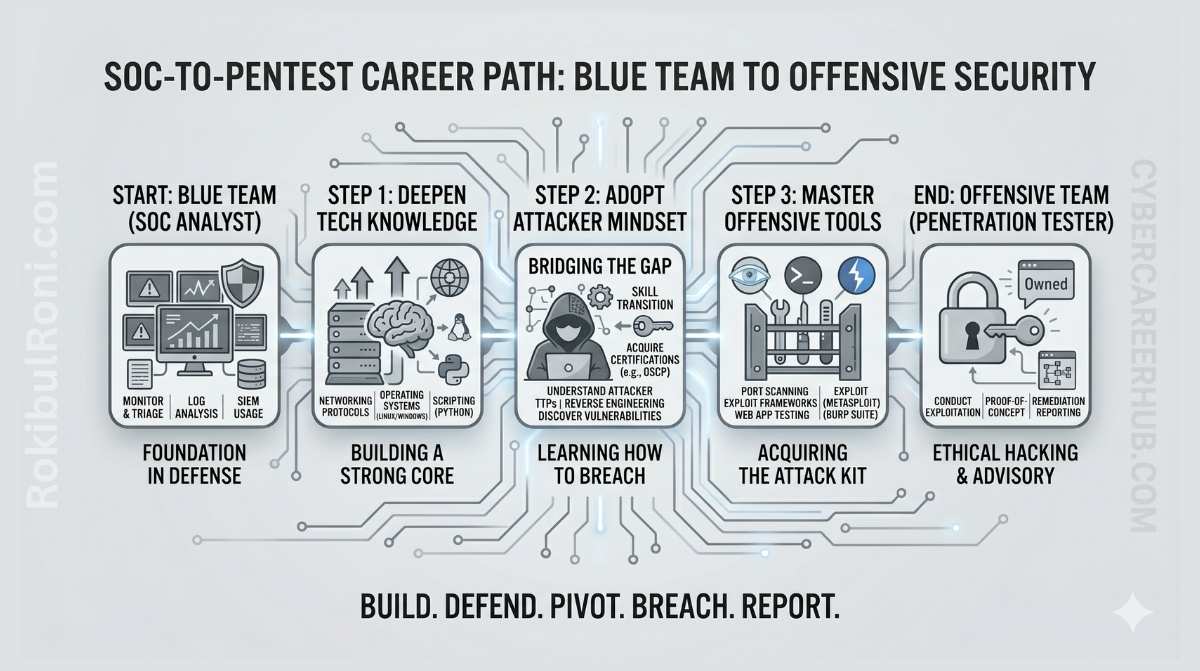
If you’re moving from the SOC to penetration testing, you have an unfair advantage that most new pentesters don’t get: you already know what real attacks actually look like in logs and telemetry. You understand how incidents actually unfold under pressure. You know what quality evidence incident responders actually need to act on findings.
That experience is gold in offensive security. It makes your testing more purposeful, your validation safer, and your findings actually useful to the people who have to fix them.
Moving from SOC to penetration testing: your transition roadmap
This guide is designed as a practical transition plan from defensive operations to junior-level penetration testing work.
1) Why your SOC background is actually an offensive advantage
You already read logs and pattern-match suspicious behavior—that’s core penetration testing discipline, just applied differently. You understand attacker timelines and can see exactly where detection breaks down. You know what evidence quality defenders actually need to respond effectively. You’re used to triage, escalation, and explaining technical issues to non-security people. And you’ve seen security constraints in real production environments, not just lab scenarios.
This combination makes your penetration testing work realistic, measured, and immediately actionable for the organizations you test. That’s rare in junior pentesters, and it’s a huge hiring advantage.
2) What your SOC skills actually transfer to offensive work
Log analysis taught you to see behavior patterns across multiple events. In testing, this becomes validation across attack chains—proving impact, not just individual findings.
Network traffic reading gave you context about protocol behavior and flow anomalies. Pentesters use this same skill for recon and understanding service behavior under your test scenarios.
Timeline building is how you connected incidents to business impact. Pentesters use the same skill to construct attack narratives—showing how an attacker moves through the environment step-by-step.
Alert triage trained you to separate signal from noise quickly. This becomes testing prioritization—focusing on what actually matters, not alert fatigue over every minor finding.
Understanding vulnerability context means you already know the difference between “this is flagged by a scanner” and “this is actually urgent for this business.” That judgment is worth its weight.
Business communication is maybe your biggest advantage. Most technical pentesters struggle with this. You don’t—you already explain complex security issues to non-technical stakeholders regularly.
This focus on outcomes and context is exactly what separates junior pentesters who get hired and retained from those who just chase tool outputs.
3) What you need to learn that’s different from SOC work
Your SOC foundation is strong, but offensive testing requires some genuinely new skills and approaches.
Technical skills you need to build
Web application testing is different from incident response. You need to understand the actual workflow—enumerating endpoints, testing authorization logic, validating input handling, finding business logic flaws.
API testing is becoming critical. You need a methodology for testing role-based access, function-level authorization, and workflow abuse. This isn’t something SOC work teaches naturally.
Burp Suite is the industry standard, and you need to use it properly—not just running the auto-scanner and reading the output, but actually thinking through the application and using manual techniques alongside automation.
OWASP Top 10 and OWASP API Top 10 should be reference materials you actually understand, not just lists you’ve memorized.
Nmap reconnaissance discipline means understanding what you’re looking for, documenting it clearly, and connecting recon output to actual testing priorities.
Scripting (Python or Bash) for validation tasks will save you enormous time and make your testing repeatable.
Delivery and professionalism
Finding writing is different in offensive work. You need to write CVSS scoring, translate impact to business terms, suggest realistic remediation steps. This is more technical than incident reporting.
Safe validation principles mean proving vulnerability with the minimum evidence necessary—no need to fully exploit everything.
Retest methodology is how you verify fixes actually worked and didn’t create new issues.
Legal and scope understanding is non-negotiable. Testing within scope, respecting rules of engagement, and understanding the legal framework is fundamental to professional pentesting.
How your growth looks across these areas
| Skill | Where You Start (from SOC) | Where You Need to Be (Junior Pentester) |
|---|---|---|
| Web/API Testing | You know what the alerts look like; you don’t know how to test apps | You can run systematic testing workflows on applications and APIs |
| Reconnaissance | You understand asset inventory; you’re not looking for entry points | You can build recon maps that guide testing priorities |
| Tools | You know SIEM tools; you’re not familiar with testing tools | Burp, Nmap, and API testing workflows are natural to you |
| Scripting | You can write basic automation; you haven’t built test scripts | You write small tools that make your testing repeatable |
| Reporting | You write incident summaries and escalations | You write finding reports with CVSS, impact, remediation, retest criteria |
| Legal/Ethics | You know the general policy framework | You’re disciplined about scope and authorization-first execution |
4) Your six-month transition timeline
This roadmap is realistic for working professionals learning part-time while keeping your SOC job.
Month 1: Foundation reset
You know security, but you need to understand web application mechanics from a tester’s perspective. Spend time on HTTP fundamentals, authentication and session mechanics, and access control logic. Set up a basic web testing lab with good logging so you can see what’s happening. Create a template for how you’ll document findings—you’ll use this every month after this.
Month 2: Web testing discipline
Learn Burp Suite properly—project setup, scope control, how to manually analyze requests rather than just running the scanner. Test authentication, authorization, input validation, and error handling in labs you build or use (DVWA, WebGoat, etc.). Write 3 sample findings using your template. By the end of month 2, you should feel competent with basic web testing workflows.
Month 3: API testing
APIs are everywhere, and API testing is different from web app testing. Build a role-based API workflow using Postman and Burp together. Practice authorization checks at the object level (can I see data that’s not mine?) and function level (can I do things I’m not supposed to?). Improve your finding format with proper CVSS scoring and remediation guidance that developers can actually implement.
Month 4: Reconnaissance and targeting
Learn scoped reconnaissance methodology—mapping assets, understanding services, validating exposure. Get comfortable with Nmap and understand what data it gives you. Most importantly, practice connecting recon findings to actual testing priorities. This is where pentesters separate signal from noise.
Month 5: Reporting and verification
Focus on improving your remediation writing so developers can actually implement your recommendations. Practice retest cycles—find an issue, document it, fix it, verify the fix works. Write one complete engagement-style report from scope statement through findings to retest verification. This is your first portfolio piece.
Month 6: Job readiness
Polish up public-safe writeups from your labs and contribute helper scripts to GitHub. Update your resume to show the progression from SOC to offensive testing. Practice explaining your projects to interviewers—focus on the workflow, evidence, and thinking, not just the tools.
5) Labs that actually build your portfolio
Choose labs that teach offensive work while producing real artifacts you can show hiring teams.
Web application labs (DVWA, Juice Shop, or similar) should focus on testing access control, input validation, and business logic flaws. Your output: one finding report per application showing your methodology.
API labs teach authorization testing at scale. Use Postman and Burp together to test role-based access, function abuse, and workflow validation. Output: an API test matrix showing what roles can and can’t do.
Network reconnaissance labs let you practice scoping recon, mapping services, and understanding exposure. Use Nmap and related tools on authorized lab networks. Output: a clean recon evidence sheet that shows what you found and how you prioritize it for testing.
Home SIEM lab bridges offense and defense—set up logging for your test environment so you can see what your attacks look like from a detection perspective. This is unique and valuable. Output: a report on detection gaps you found in your test environment.
Cloud labs for testing IAM, logging, and baseline hardening. Many organizations need this expertise. Output: a baseline security checklist and gap analysis.
Packet analysis for understanding traffic-level details. Useful for network-focused testing. Output: investigation timelines showing attack flow.
The critical principle: every lab should produce something you can add to your portfolio—not just “I completed a challenge,” but “I performed testing and documented findings.”
6) Certifications: useful structure, but not the main event
Certifications can give you learning structure and provide a hiring signal, but they should validate work you can already do—not replace it.
The right approach: Use certifications to structure your study topics and create momentum. But pair every study module with a hands-on lab output. Don’t collect multiple certs without project evidence behind each one. Skill depth and reporting quality matter far more than badge count.
Time allocation that works:
- 40% hands-on lab work and testing
- 30% writing reports and practicing communication
- 20% foundational refresher (networking, web fundamentals, cloud basics)
- 10% actual exam prep if you’re going for a cert
This keeps you grounded in practical work, not just certification study.
7) Your portfolio: what actually convinces hiring teams
Portfolio quality is about showing your methodology and thinking, not making flashy claims or impressive tool names.
Case studies from your labs that show scope, methodology, findings, and remediation. These should be redacted for confidentiality, obviously, but they show how you actually think.
Finding samples from your testing with proper formatting—title, impact, evidence, remediation, retest status. This is what technical interviewers will actually scrutinize.
Helper scripts you’ve written for validation or reporting. Nothing fancy, just tools that actually solve problems you encountered.
Detection-to-testing notes that uniquely leverage your SOC background. “Here’s what this attack looks like in logs” combined with “here’s how to test for it” is gold.
Methodology explanations showing you understand authorized testing, safe validation, scope discipline.
What hiring teams actually evaluate
| Portfolio Item | This Looks Professional | This Doesn’t |
|---|---|---|
| Lab Report | Shows clear objective, methodology, evidence, remediation steps | Just lists which tools you used |
| GitHub Script | Solves an actual validation problem, has README, works | Random scripts dumped with no context |
| Finding Sample | Proper formatting with impact assessment and retest criteria | Screenshot dump with no narrative or structure |
| Career Story | Explains how your SOC experience improves offensive work | Generic “I love cybersecurity” statements |
One strong lab report beats five weak ones. Always.
8) The transition mistakes to avoid
Skipping web fundamentals to jump straight to Burp Suite. You need to understand HTTP, sessions, authentication, and authorization logic before tools make sense. Take the time upfront.
Chasing payloads and wordlists instead of actually learning testing methodology. Scanning with tools feels productive but teaches you almost nothing. Learn the workflow first.
Weak writing and sloppy evidence. SOC analysts are used to short, urgent communication. Pentesting reports need structured findings with proper evidence and remediation guidance. This is a different muscle to build.
Losing sight of legal and authorization boundaries. Your SOC training emphasized working within policy. Pentesting adds a new layer—explicit scope, rules of engagement, signed agreements. Don’t develop bad habits in labs.
Wasting your blue-team advantage. Most junior pentesters don’t understand detection and incident response. You do. Use it. Talk about how findings will be detected, what incident response implications exist, how defenders will verify fixes.
Building portfolio work that can’t be reproduced. If you can’t walk someone through your lab methodology step-by-step, it’s not portfolio-ready.
Simple standards to stay on track
- Every lab produces a finding writeup (even if it’s just a sample finding)
- Every finding includes remediation guidance and retest criteria
- Every month, publish something—a script, a blog post, a case study, something
9) How to track progress: monthly assessment
Ask yourself these questions each month and score yourself 1-5:
- Testing Process: Can I run a complete scoped test workflow cleanly, or am I still chaotic?
- Evidence Quality: Are my findings reproducible if I walk someone through them?
- Remediation: Can developers actually implement my recommendations, or are they vague?
- Defensive Context: Do I explain impact using what I know about detection and incident response?
- Tool Mastery: Am I using tools intentionally to answer questions, or just mechanically running scans?
- Communication: Can I brief both technical and non-technical people effectively?
Track these monthly. You’ll see real growth over six months if you’re working deliberately.
10) Your interview strategy and role targeting
When interviewers ask about your transition from SOC to pentesting, here’s how to frame it:
- ”I test like a defender:” Focus on real impact and clean evidence, not hype or exaggeration.
- ”I map findings to detection:” This is unique to your background. Explain how attackers look in logs and how your testing addresses detection gaps.
- ”I write for engineers:” My reports give developers what they need to actually fix things, not just compliance theater.
- ”I understand operational pressure:” I test safely because I know what incident response actually looks like under stress.
Role sequence that works: Start with security analyst roles that include offensive validation responsibilities. Then move to junior pentester or associate consultant roles. Hybrid AppSec + pentest roles can be great if they have reporting ownership. This path is faster and more sustainable than trying to jump directly into specialized red team work.
11) Your 90-day execution plan: from here to job-ready
Days 1–30: Foundation Set up a solid lab and testing template. Complete two meaningful web/API workflow exercises. Publish your first structured writeup showing your methodology.
Days 31–60: Depth Add recon methodology and deeper API authorization testing. Produce one complete mini-engagement report from scope through retest. Improve your CVSS scoring and remediation writing quality. Start recording interview stories about what you’ve done.
Days 61–90: Readiness Assemble one polished case study that shows your complete workflow. Practice explaining your projects to interviewers. Build a targeted application package for junior pentester roles. Apply strategically and learn from feedback.
What hiring managers actually look for
By the time you’re ready to apply, have these artifacts ready:
2–3 clean lab writeups showing your methodology—scope, testing approach, findings, remediation. These don’t need to be perfect, but they need to be clear and reproducible.
A sample finding in your final format: clear title, impact statement, evidence showing it’s real, remediation guidance, and retest criteria.
Demonstrated scope discipline. Show in interviews that you understand authorization, rules of engagement, and safe testing principles.
Interview talking points
| When They Ask | Your Response |
|---|---|
| Why move from SOC to testing? | “I understand detection and incident response, which makes me a safer, more realistic pentester. I test findings that actually matter.” |
| How do you validate findings? | “I document my methods and evidence so others can reproduce and verify my work.” |
| How do you prioritize risk? | “I map findings to business context and detection implications, not just CVSS scores.” |
| How do you work with engineering? | “I focus on remediation guidance they can actually implement and verify.” |
Practical prep checklist
- Practice answering scoping and rules-of-engagement questions
- Write a strong one-page executive summary explaining an assessment
- Practice explaining finding severity with nuance, not hype
- Walk through your retest and closure methodology
The best SOC-to-pentest transitions use your defensive background as a competitive advantage: disciplined execution, strong evidence quality, findings that defenders can actually act on, and constant connection between offensive work and defensive reality.