Table of Contents
- Introduction
- Understanding Tier-1 SOC Architecture
- Designing the Physical SOC Room
- Staffing a 24/7 SOC in Malaysia
- Tier-1 Shift Handover Playbooks
- Creating a Smart 24/7 Shift Rota
- Tools, Tech & Local Compliance
- Metrics & Continuous Improvement
- Conclusion
Introduction
”Malaysia has seen a sharp rise in ransomware, data breaches, and financial fraud in recent years. Threat actors work around the clock—they don’t care about your time zone or public holidays. Your defensive team can’t afford to sign off at 5 p.m.” (For more context, see Top 10 Cybersecurity Threats to Watch in 2026)
Malaysia’s push toward a multi-billion-dollar digital economy under the MyDIGITAL blueprint by 2030 has brought a more complex threat landscape with it. A wider digital footprint means more attack surface, and regulatory frameworks like the Personal Data Protection Act (PDPA) and Bank Negara Malaysia’s Risk Management in Technology (RMiT) carry real compliance teeth. Add a persistent talent shortage into the mix, and building capable in-house security becomes genuinely difficult. For most mid-to-large enterprises today, a 24/7 Tier-1 Security Operations Center (SOC) is no longer a nice-to-have—it’s a core pillar of operational resilience.
New to SOC careers or looking to upskill your team? Start with The Ultimate Guide to SOC & SIEM Careers (2025).
This guide is a practical blueprint covering people, processes, and technology—everything you need to architect and run an always-on Tier-1 SOC. It’s written for the Malaysian context, covering physical room layout, smart shift rotas, regulatory compliance, and the handover playbooks that stop critical alerts from falling through the gap between shifts.
Understanding Tier-1 SOC Architecture
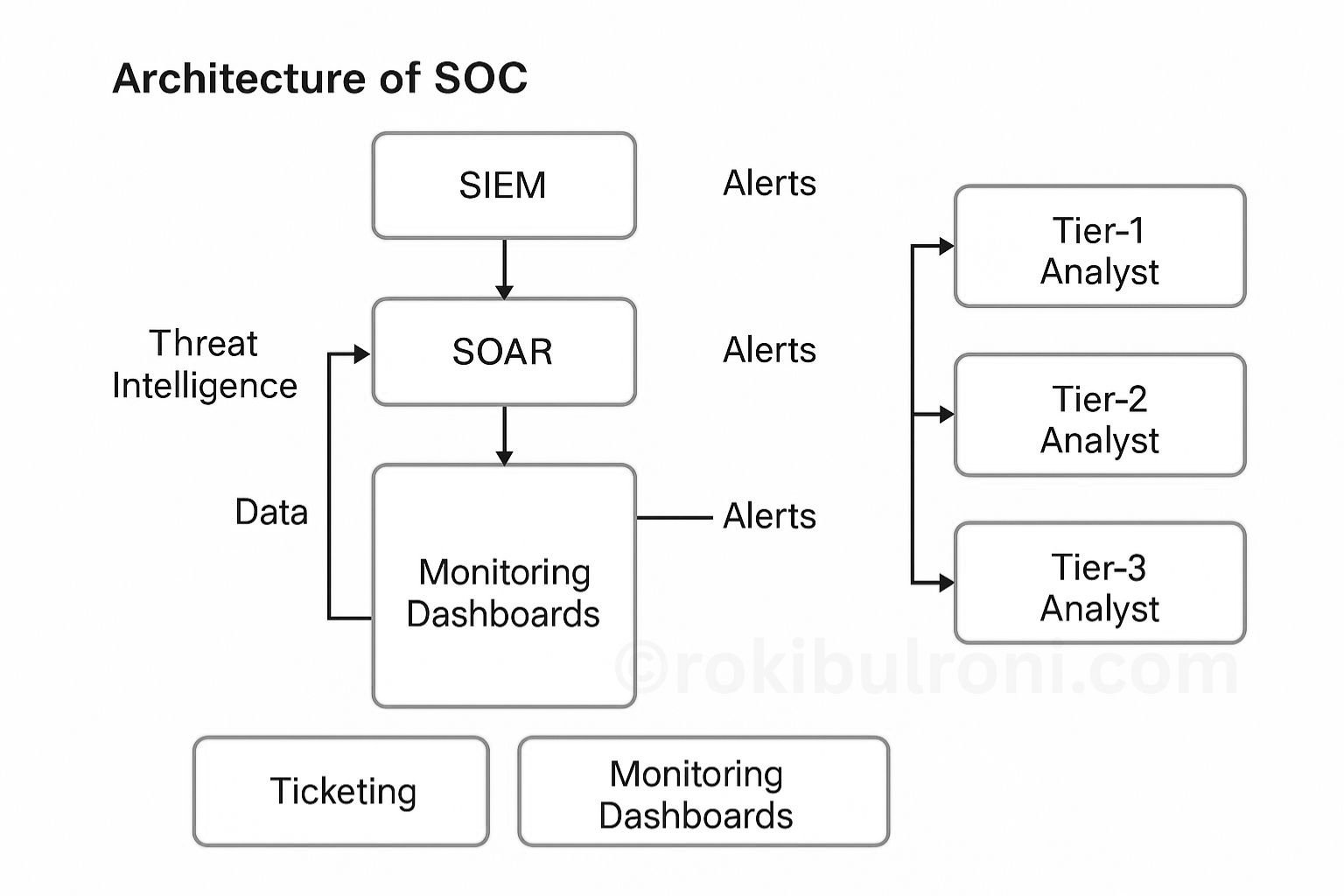
A high-performing SOC isn’t built by buying the most expensive SIEM on the market. It’s a tightly integrated ecosystem built on three foundational pillars that work together to cut through noise and surface real threats before they escalate.
1. The Three Pillars of SOC Operations
| Pillar | Core Deliverable | Common Pitfalls |
|---|---|---|
| People | Continuous 24/7 “eyes-on-glass”; first-level alert triage and initial containment. | Alert fatigue, severe burnout, high staff turnover (churn). |
| Process | Repeatable escalation workflows, incident logging, and shift handovers. | Over-reliance on tribal knowledge, outdated Standard Operating Procedures (SOPs). |
| Technology | The integrated toolchain that drives detection to automated response. | Siloed data sources, excessive tool sprawl, untuned rules leading to noise. |
2. Logical Building Blocks of the SOC
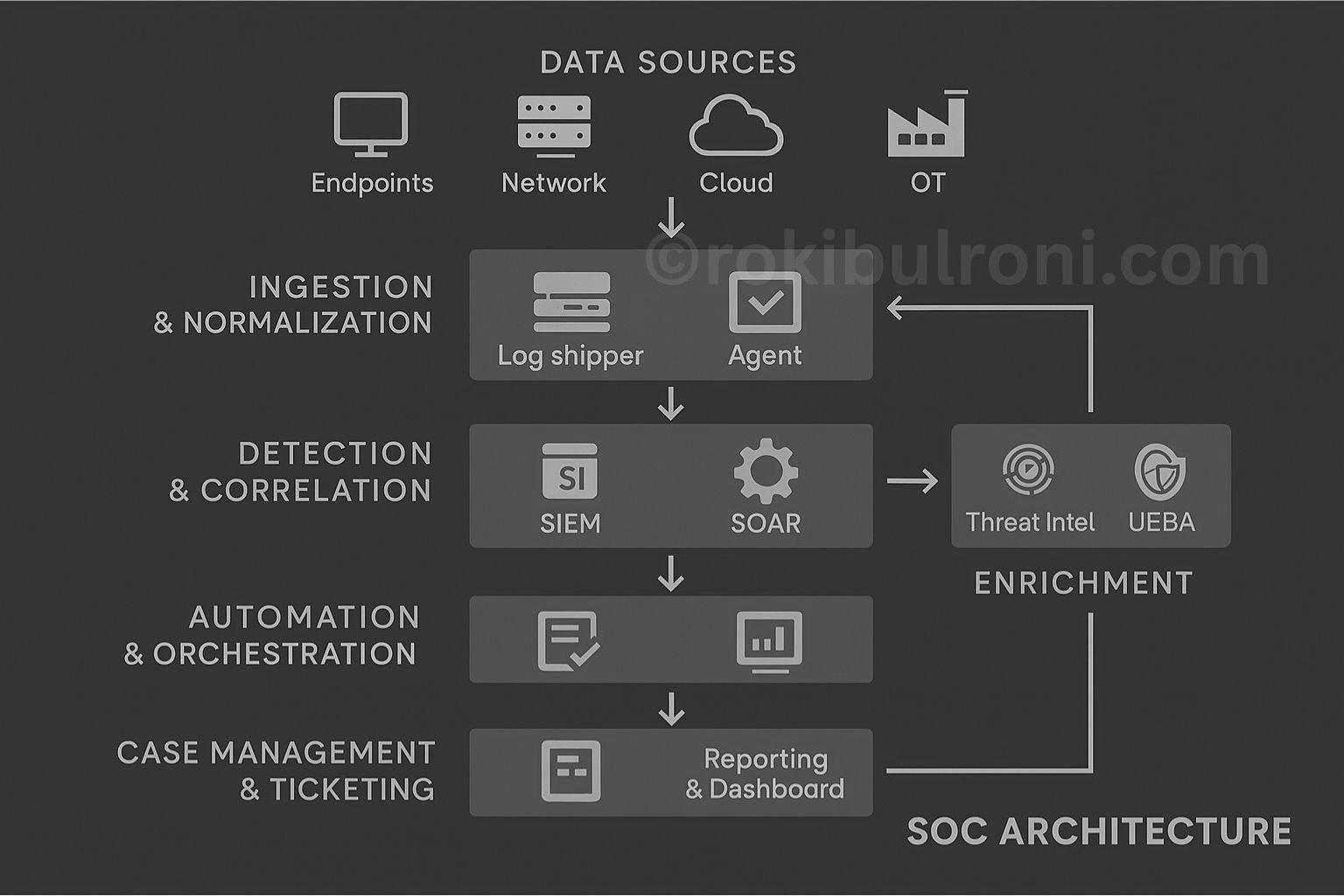
A modern Tier-1 architecture should automatically ingest, enrich, and surface contextualized data to analysts—so they can make fast, informed decisions instead of hunting for context under pressure.
| Architectural Layer | Typical Tooling | Tier-1 Analyst Focus |
|---|---|---|
| Data Collection | Log shippers, NetFlow taps, EDR agents, API webhooks. | Validating data ingestion health and identifying blind spots. |
| Correlation & Detection | SIEM (e.g., Microsoft Sentinel, Splunk, Elastic). | Investigating triggered rules and correlation events. |
| Automation & Orchestration | SOAR (e.g., Swimlane, Cortex XSOAR). | Verifying automated actions and closing benign false-positives. |
| Enrichment | Threat Intelligence Platforms (TIP) like MISP, UEBA, Sandboxing. | Hunting for surrounding context (e.g., assessing IP reputation). |
| Case Management | Jira, ServiceNow, TheHive. | Documenting IoCs, timeline of events, and escalating with hard evidence. |
Expert Tip: Wire your SOAR playbooks directly into IAM APIs to auto-disable compromised accounts, and into edge firewalls to block malicious IPs on confirmation. Automating these low-risk, high-impact containment steps can meaningfully cut your Mean Time to Respond (MTTR)—without adding headcount. (Unsure whether you need SIEM, SOAR, or both? Read: SIEM vs SOAR — Which One Do You Need?.)
Designing the Physical SOC Room
Why physical layout dictates incident outcomes
Ergonomics are directly tied to cognitive performance. Studies on mission-critical control rooms show that indirect lighting, acoustic dampening, and proper monitor placement lower cortisol levels by up to 18%. In a high-stakes environment, lower stress translates directly to faster, more accurate decision-making.
If your team works on-site, the physical environment directly affects how well they perform across long, demanding shifts. This isn’t about aesthetics—it’s about sustained cognitive output.
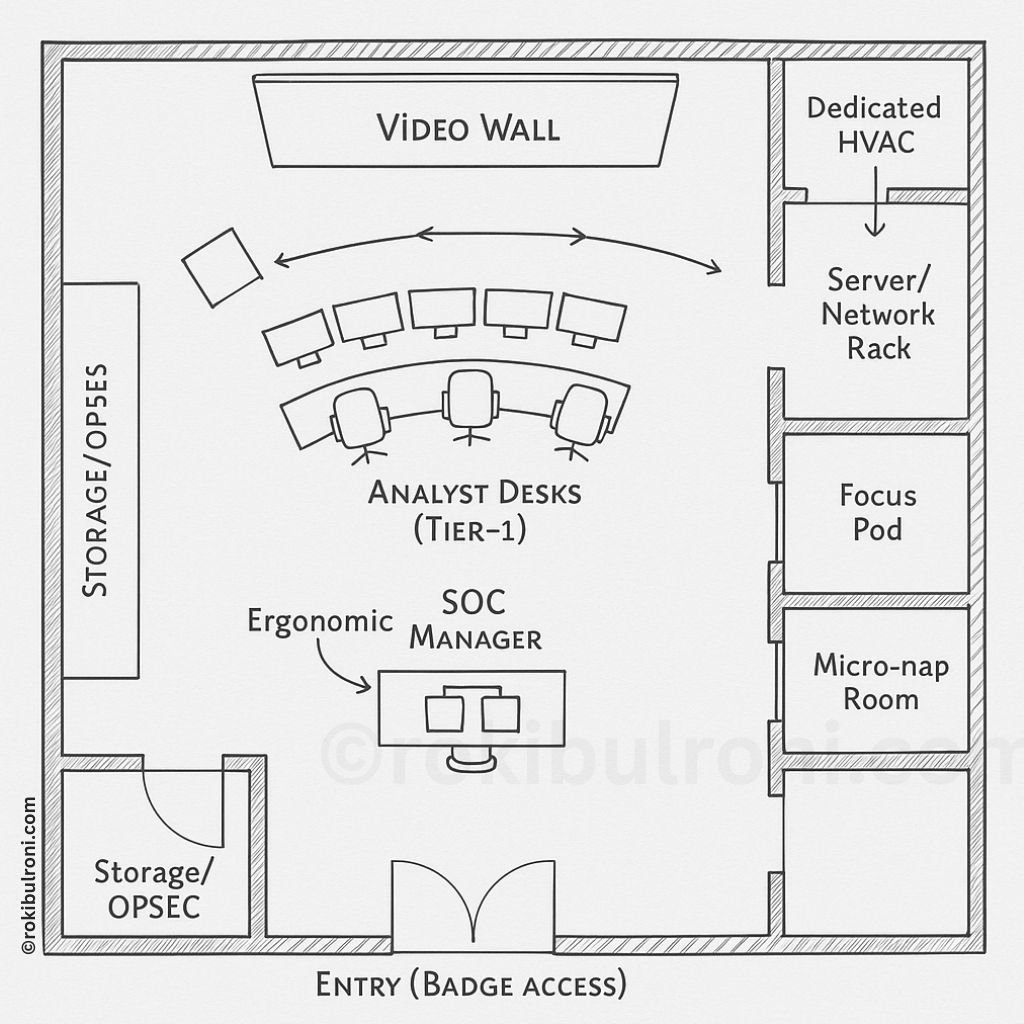
Essential Layout Considerations
- Location & OPSEC: Put the SOC in a windowless, badge-controlled room in a secure, low-profile part of the building. Access controls need to be tight enough to prevent tailgating.
- Sight-Lines & Collaboration: Semi-circular desks facing a central video wall or large-format monitors work best. Analysts shouldn’t have to turn away from the main display to talk to the colleague sitting next to them.
Staffing a 24/7 SOC in Malaysia
Building a capable SOC team in Malaysia means competing in one of the tightest talent markets in the region. You’ll go head-to-head with major banks and multinational tech hubs in Cyberjaya and Kuala Lumpur for the same pool of qualified analysts.
1. The Operational Pyramid
To maintain genuine 24/7 coverage once you factor in annual leave, sick days, and training time, you need more analysts than the shift math suggests at first glance.
| Tier | Required Headcount* | Core Responsibilities | Skills Snapshot |
|---|---|---|---|
| Tier 1 (Triage) | 10 - 12 | Continuous monitoring, alert triage, initial containment, escalation. | Network fundamentals (TCP/IP), OS internals, MITRE ATT&CK framework. |
| Tier 2 (Incident Response) | 4 - 6 | Deep-dive incident response, complex malware analysis, containment coordination. | Memory forensics, packet carving, advanced EDR querying. |
| Tier 3 (Engineering/Hunting) | 2 - 3 | Proactive threat hunting, SIEM rule tuning, custom playbook development. | Sigma/YARA rules, Python scripting, API integrations. |
| SOC Manager | 1 | Strategic direction, metric tracking (KPIs), vendor management, HR liaison. | ITIL framework, budget management, leadership and coaching. |
*Note: Assumes 24/7 cover utilizing 12-hour shifts, inclusive of a ~25% leave buffer.
2. Market Realities & Retention Strategies
- The Talent Gap: Malaysia’s cybersecurity workforce shortfall is real and growing. Passive hiring won’t fill your roster—actively recruit, build referral networks, and invest in upskilling internal staff who show aptitude.
- Compensation Benchmarks: Entry-level Tier-1 analysts expect market-competitive salaries. Financial institutions bound by RMiT consistently pay a 20–30% premium over the standard rate to lock in qualified talent.
- Retention: Burnout is the single biggest threat to a SOC team’s effectiveness. Counter it with clear promotion paths, funded certifications (BTL1, CompTIA CySA+, SANS courses), AI-assisted triage to remove the most repetitive work, and humane shift patterns that don’t grind people down within their first year. Looking to build a personal development plan? Check our Cybersecurity Career Accelerator.
Tier-1 Shift Handover Playbooks
More incidents escalate—or get missed entirely—during shift changes than most teams want to admit. When an analyst who’s been tracking a slow-burning incident for hours hands off in a rushed two-minute conversation, critical context evaporates. A structured, repeatable handover process is what stops alerts from falling through the gap between shifts.
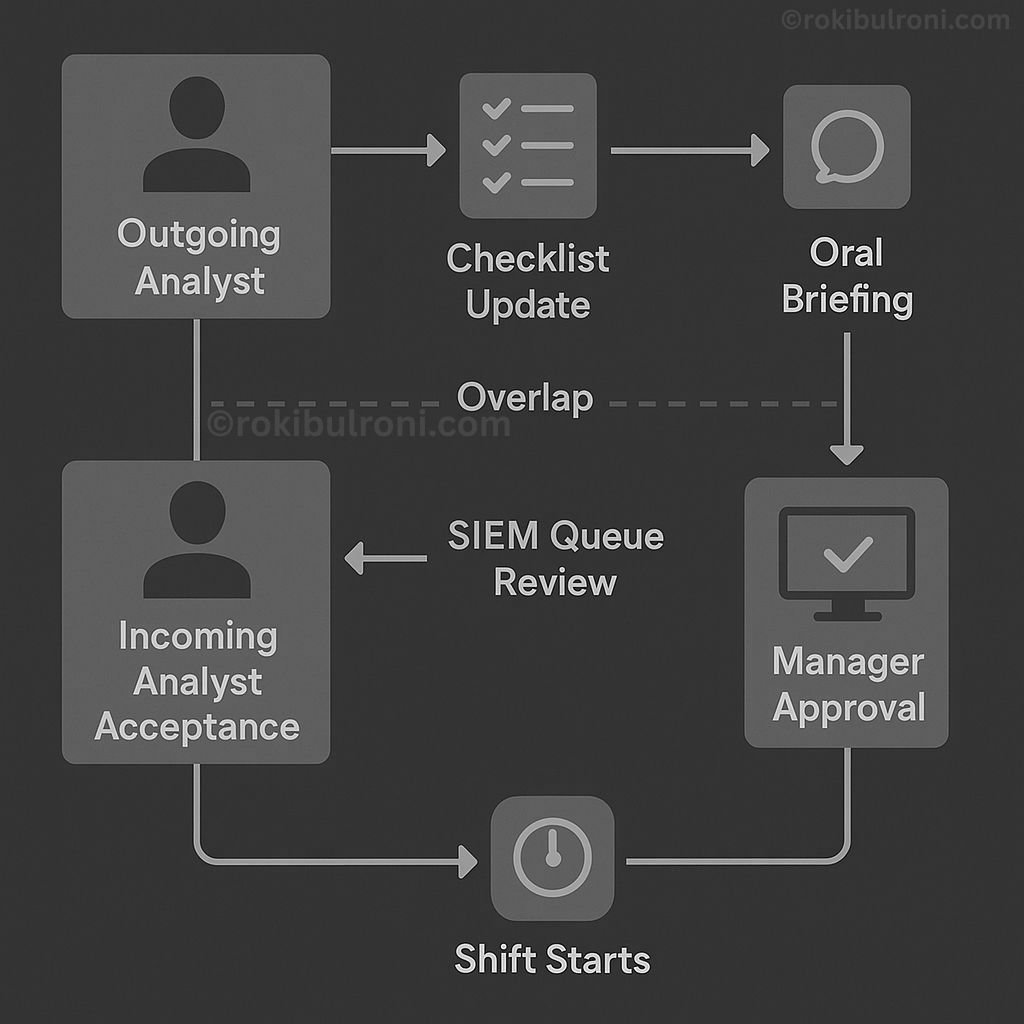
Best Practice: Drop email handovers entirely. Move to a digital, auditable checklist inside your ticketing system—Jira Service Management works well—that requires dual sign-off before any shift closes. (For more detailed analyst-level SOPs, check out Incident Response Playbook for Small Teams for templates and field-tested lessons.)
Creating a Smart 24/7 Shift Rota
The shift pattern you choose has a direct impact on your team’s wellbeing—and by extension, their detection quality. A poorly designed rota is a reliable pipeline to alert blindness and high turnover.
Evaluating Rota Patterns
| Rota Pattern | Cycle Length | Pros | Cons |
|---|---|---|---|
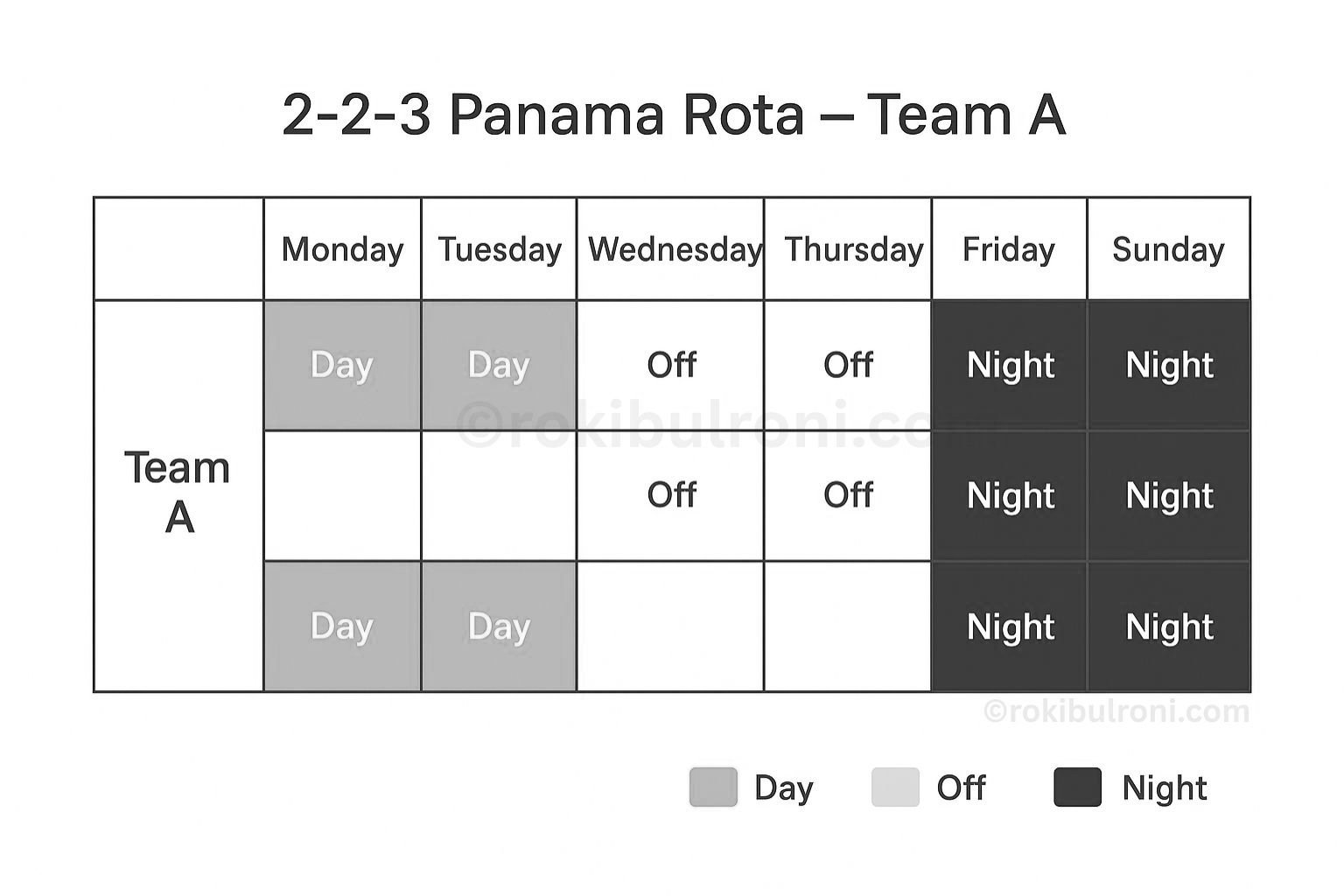
| Panama (2-2-3) | 28 days | Provides equal weekends off, highly predictable schedule for family life. | Requires working two to three consecutive 12-hour nights. |
| Dupont | 28 days | Personnel never work more than 4 consecutive night shifts. | Highly complex to track and manage shift swapping. |
| 4-On / 4-Off | 8 days | Generous, continuous blocks of rest time. | Shifts do not align with standard weeks, leading to irregular pay/weekend cycles. |
Example Panama Pattern (Team A): Monday (Day) ▶ Tuesday (Day) ▶ Wednesday (Off) ▶ Thursday (Off) ▶ Friday (Night) ▶ Saturday (Night) ▶ Sunday (Night).
The “On-Call Shadow” Strategy: Keep a secondary analyst on a paid on-call retainer during high-risk shifts. If a ransomware outbreak floods the queue with alerts, they need to be VPN’d in and contributing within minutes—not scrambling to find their laptop.
Tools, Tech & Local Compliance
In Malaysia, every tool you procure needs to be measured against your regulatory obligations. Bank Negara’s RMiT and the PDPA set clear expectations around data handling, log retention, and how quickly you’re required to report incidents.
| Control Objective | Relevant Regulation (PDPA / RMiT) | Practical Technical Implementation |
|---|---|---|
| Log Retention | PDPA §9, RMiT 11.6 | Cloud-native SIEM configured with strict Malaysian region data storage (Data Residency). |
| Continuous Monitoring | RMiT Part C §10.22 | Comprehensive EDR deployment backed by 24/7 SOC “eyes-on-glass”. |
| Rapid Breach Notification | PDPA Amendments (≤72 hours) | SOAR playbooks that auto-generate executive summary reports upon P1 incident confirmation. |
| Identity Risk Profiling | RMiT Appendix 3 | MFA enforcement paired with UEBA to flag anomalous geographic or behavioral logins. |
Procurement & Short-Listing Advice
- Prioritize Data Residency: Cloud vendors need to offer data centers in Kuala Lumpur or Cyberjaya. If they can’t, you’re looking at a hybrid or fully on-premises deployment to keep auditors satisfied.
- Demand API-First Solutions: A modern SOC runs on integrations. Any tool without well-documented REST APIs will bottleneck your Tier-3 engineers when they try to build custom workflows.
- Look for Native Machine Learning: Pure rule-based detection struggles to keep pace with modern threat volume. Behavioral ML models that cluster related alerts can trim your Tier-1 queue by 30–40%.
- Read the Licensing Fine Print: EPS (Events Per Second) pricing gets expensive fast once you start ingesting high-volume cloud logs like AWS CloudTrail or Azure AD events. Cost-per-gigabyte models tend to be far more predictable at scale.
Metrics & Continuous Improvement
If you’re not measuring SOC performance, you can’t improve it. But the metrics you track matter—measuring “alerts closed” just rewards whoever dismisses the most tickets. Focus on speed and accuracy instead.
| Essential KPI | Healthy Benchmark | Danger Zone | Why It Matters |
|---|---|---|---|
| Mean Time to Detect (MTTD) | < 30 - 60 mins | > 4 hours | Faster detection minimizes the adversary’s dwell time and operational blast radius. |
| Mean Time to Respond/Contain (MTTR) | < 4 hours | > 24 hours | A direct reflection of your SOAR efficiency and procedural agility. Directly impacts financial loss. |
| False-Positive Rate | < 25% (for P1s) | > 50% | High false positives breed alert fatigue, causing analysts to ignore legitimate threats. |
| Analyst Capacity Buffer | > 15% | < 5% | You must maintain operational slack to absorb sudden surges during a major incident. |
| Playbook Update Cadence | Quarterly | Annually | Threat actor Tactics, Techniques, and Procedures (TTPs) evolve constantly; static playbooks become obsolete rapidly. |
Institutionalizing Feedback Loops
- Post-Incident Reviews (PIR): Run a blameless PIR within 48 hours of any significant incident. Capture the root cause, any detection gaps, and update your rules before the threat has a chance to repeat.
- Quarterly Table-Top Exercises (TTX): Simulate realistic scenarios—a supply chain compromise, a ransomware outbreak—to stress-test your handover process, rotas, and escalation paths under real pressure.
- Analyst Net Promoter Score (NPS): Keep a close eye on team morale. If analysts are burning out or drowning in false positives, detection quality drops fast—often before leadership notices.
Pull these metrics automatically from your SIEM and SOAR, and pipe them into a live Grafana or Power BI dashboard for leadership visibility. In cybersecurity, what gets measured tends to get resourced.
Conclusion
Building a 24/7 Tier-1 SOC in Malaysia isn’t a one-time project—it’s an ongoing balancing act between systems engineering, regulatory compliance, and people management. Automation handles the noise. A well-designed environment and fair scheduling keeps analysts performing at their best. And real investment in training and career development keeps the team you’ve built from walking out the door.
Track the right metrics, keep your playbooks current, and stay aligned with your RMiT and PDPA obligations—and what you’ll end up with is worth far more than a compliance checkmark. You’ll have a resilient, sustainable operation that can actually defend your organization against modern adversaries, every hour of every day.