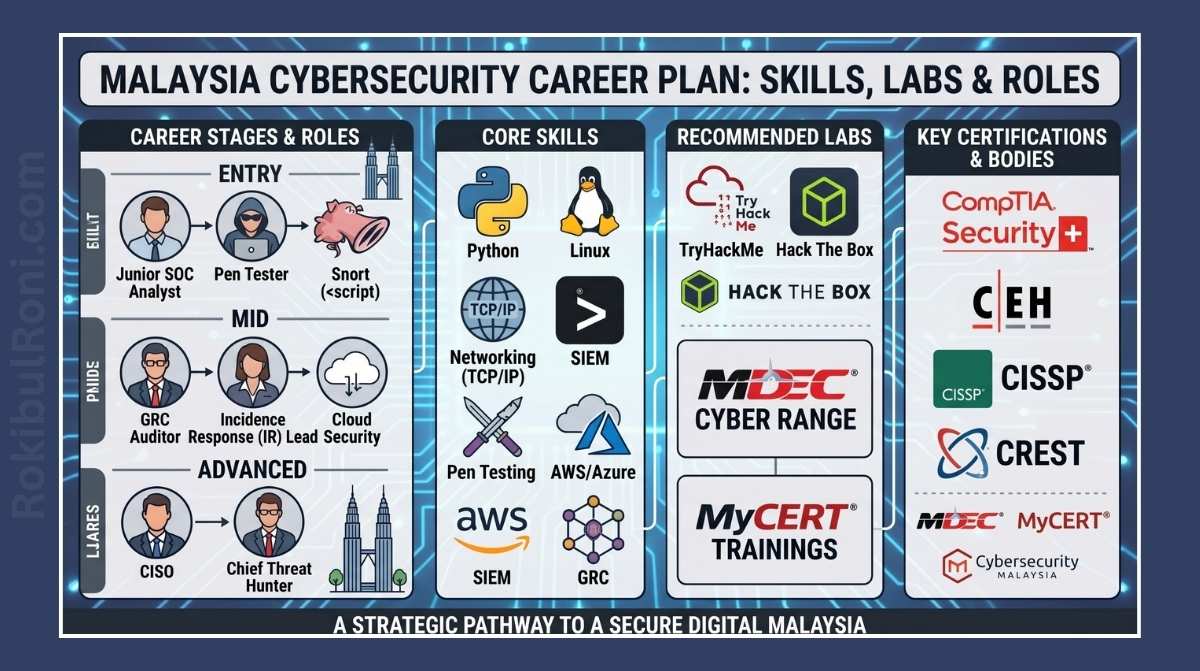
Building a strong cybersecurity career in Malaysia isn’t about collecting certificates—it’s about demonstrating real capability. Malaysian employers, whether in banking, government, or enterprise sectors, want proof you can solve genuine technical problems, document your findings clearly, and work reliably under operational pressure.
The most direct path forward combines three things: solid fundamentals, hands-on lab evidence, and clear communication skills. When these three develop together, your portfolio becomes credible before you even step into your first full-time security role.
Your cybersecurity career plan for Malaysia
This is a practical roadmap designed for students, fresh graduates, and career switchers in the Malaysian tech ecosystem.
1) Why fundamentals and portfolio evidence matter
Cybersecurity work rests on strong fundamentals—networking, systems administration, and systematic troubleshooting are non-negotiable. Labs take that theory and transform it into demonstrable technical skill that employers can evaluate. Being able to write clear reports and communicate findings professionally signals you’re ready for real responsibility. Here’s what matters: employers trust hands-on evidence far more than resume keyword-stuffing. A structured learning path also keeps you focused, preventing the trap of tool-chasing that burns out so many early-career professionals.
Bottom line: a practical portfolio of real work samples beats a long list of generic certifications every time in hiring conversations.
2) Role paths to choose from early
You don’t need to lock yourself into a specialization on day one, but picking an initial direction keeps your learning focused and your portfolio cohesive.
| Role Path | Core Focus | What You’d Actually Do Early On |
|---|---|---|
| SOC Analyst | Alert triage, incident detection, monitoring | Review alerts, analyze logs, escalate suspicious activity |
| Penetration Tester | Authorized security testing | Reconnaissance, vulnerability validation, findings documentation |
| Cloud Security Analyst | Cloud infrastructure hardening | Baseline security reviews, IAM configuration, logging validation |
| GRC Analyst | Risk governance, compliance | Control mapping, audit coordination, policy documentation |
| Incident Responder | Investigation and containment | Timeline reconstruction, evidence handling, response coordination |
| Vulnerability Analyst | Risk prioritization | Scan validation, severity assessment, retest verification |
How to pick your starting path
Ask yourself what actually interests you in a typical day: monitoring systems and hunting threats? Then SOC is your entry. Enjoy hands-on testing and finding vulnerabilities? Penetration testing or AppSec is the fit. Prefer architecture and governance work? Cloud security or GRC aligns better.
Your first role is never permanent—it’s a starting platform. Many successful security leaders have switched paths two or three times before finding their ideal fit.
3) Foundation skills every path needs
Whatever role you’re aiming for, these technical and professional fundamentals are non-negotiable.
Core technical foundations
Networking – You need to understand TCP/IP, DNS behavior, routing, and how common ports and protocols actually work in practice.
Linux and Windows systems – Know how to navigate both operating systems, read logs effectively, understand authentication mechanisms, and troubleshoot basic issues.
Cloud basics – Understand IAM concepts, storage security, networking, and how to find audit logs. You don’t need to be a cloud architect, but you need basic fluency.
Scripting – Python or Bash competency for automation tasks and log parsing will save you enormous amounts of time.
Security concepts – Understand the CIA triad, access control models, basic threat modeling, and how to prioritize risk realistically.
Professional foundations (equally important)
- Structured problem solving—breaking down complex issues methodically
- Clear written communication—explaining technical findings in terms non-technical people understand
- Cross-team collaboration—working effectively with IT, developers, and business stakeholders
- Discipline in your own learning—tracking progress, sticking to a schedule
From beginner to job-ready: a practical progression
| Skill Domain | Early On | Job-Ready |
|---|---|---|
| Networking | You can identify what protocols are in use and basic troubleshooting | You can interpret suspicious traffic patterns with context |
| Linux/Windows | You can navigate systems and find relevant log entries | You can run repeatable analysis workflows independently |
| Cloud | You understand the three main service models and basic IAM | You can perform a baseline security review and document gaps |
| Scripting | You can write small helper scripts | You can automate repetitive security tasks reliably |
| Communication | You can explain findings in plain language to peers | You can write actionable reports that others can implement |
4) Lab path that builds real capability
The key to labs that actually help is designing them to mirror real security workflows—the ones your future team will actually use.
A practical lab sequence
Start with home fundamentals (building network and OS confidence), then move to SIEM/detection (learning how logs work and alert triage), then web application testing (understanding authentication, access control, and common vulnerabilities). Add cloud security labs once you need that exposure, and forensics labs to round out your incident investigation skills.
What each lab stage gives you
| Lab Stage | What You’re Building | What Goes in Your Portfolio |
|---|---|---|
| Home Lab | Confidence with systems and networks | Network diagram + operations checklist |
| SIEM Lab | Understanding detection logic and triage | Alert analysis examples + incident timeline |
| Web Pentest Lab | Safe testing methodology and reporting | Finding samples with remediation guidance |
| Cloud Baseline Lab | Hardening practice and security baselines | Security baseline checklist + gap analysis |
| Forensics Lab | Evidence handling and investigation discipline | Investigation report + artifact analysis |
Important: every lab output should be reproducible (someone else should be able to follow your steps), safe (no damage to real systems), and clearly documented (so you can explain it months later).
5) Tools you’ll actually need to learn
Tools matter, but remember: they support your workflow, they don’t replace your thinking.
Nmap is essential for discovering what’s running on networks and understanding service exposure—critical recon skill.
Wireshark teaches you packet-level analysis and helps with both incident response and network troubleshooting.
Burp Suite is the standard for web and API testing. Learning it properly transforms your app security capabilities.
Nessus or OpenVAS help you practice vulnerability scanning and risk prioritization.
SIEM tools (Splunk, ELK, Wazuh) are where you’ll build detection and investigation workflows—foundational SOC skills.
Autopsy is your forensics and timeline analysis tool for investigations.
Git and GitHub aren’t just development tools—they’re how you version your scripts and build visible portfolio evidence.
Python and Bash scripting save you hours on repetitive tasks and make you far more valuable operationally.
Critical point: don’t try to master everything simultaneously. Pick one or two tools per quarter and develop real depth with them. Depth beats breadth by a significant margin in the early career stages.
6) Your 12-month roadmap: from learning to job-ready
This timeline works for people learning part-time while working or studying. Adjust pacing based on your capacity.
Quarter 1: Foundation building (Months 1–3)
Focus on the fundamentals that everything else depends on. Spend time on networking, Linux/Windows basics, and security concepts. Set up a home lab and document how you built it. Start writing small technical notes about what you’re learning. By the end of Q1, you should have at least one lab writeup and one technical note published somewhere (your blog, GitHub, anywhere visible).
Quarter 2: Specialization choice (Months 4–6)
Commit to a primary path—SOC, penetration testing, cloud security, or incident response. Run 2–3 guided labs directly aligned to that path. Build your first structured report (whether it’s a security finding, incident analysis, or baseline review). This is where your portfolio starts looking role-specific.
Quarter 3: Operational depth (Months 7–9)
Add complementary skills. If you chose SOC, add web security knowledge. If you chose pentest, add proper reporting skills. Keep improving your previous artifacts—take an early writeup and make it better. Contribute useful scripts or templates to GitHub so people can actually use what you’ve built.
Quarter 4: Transition readiness (Months 10–12)
Polish your CV and portfolio specifically for your target role. Practice explaining your projects as interview stories. Start applying strategically to internships, junior roles, or transition-appropriate positions. By month 12, you should have a cohesive portfolio pack and be actively interviewing.
7) Building a portfolio that actually convinces hiring teams
Hiring managers don’t want to see your screenshots—they want to see your methodology. Here’s what actually carries weight:
Blog posts that walk through your actual workflow and explain your decisions. “I found X vulnerability, here’s how I validated it and why it matters” beats generic theory articles.
Case-study writeups (redacted for confidentiality, obviously) showing scope, methodology, evidence, and remediation guidance. These prove you can handle real work.
GitHub repositories with scripts that solve actual security problems. Include a clean README explaining what the script does, how to use it, and sample output.
Lab diagrams and architecture notes so interviewers can see you think systematically about systems.
Detection or pentest reports from authorized testing—real samples showing your findings format and communication quality.
What actually looks professional vs. what doesn’t
| Portfolio Type | This Looks Good | This Doesn’t Work |
|---|---|---|
| Blog Post | Explains your workflow, is reproducible by others, teaches readers | Generic summary of security concepts with no real examples |
| GitHub Script | Has clear README, solves a real problem, includes usage examples | Dump of random scripts with no documentation |
| Lab Report | Shows scope, methodology, evidence, remediation, lessons learned | Just screenshots with no narrative or context |
| Your Story | Connects your background to the role you’re targeting | Vague statements about being “passionate about cybersecurity” |
Key principle: a smaller portfolio of really solid work beats a huge pile of mediocre stuff. Five excellent artifacts will outweigh fifty weak ones in almost every interview.
8) Soft skills—actually more important than you might think
Technical chops get you the interview. But communication skills, reliability, and professionalism are what actually land you the offer.
Clear technical writing is non-negotiable. You’ll spend way more time writing reports and findings than running tools. Make it readable.
Cross-team collaboration matters enormously. Security isn’t siloed—you’ll work with IT, developers, and business people constantly. Learning to explain technical issues in terms they understand is invaluable.
Adaptability under changing priorities is real. Priorities shift, incidents blow up, plans change. Teams value people who roll with it professionally.
Structured communication when troubleshooting—explaining what you found, why it matters, and what happens next—builds trust instantly.
Accountability and follow-through are underrated. Do what you say you’ll do, on schedule, with quality. This alone puts you ahead of many early-career professionals.
How to actually practice these
- After every lab or project, write a one-page technical summary. This builds writing discipline.
- Pick a technical concept each week and explain it to someone non-technical. You’ll find what you don’t understand this way.
- Practice the format: “Here’s what happened. Here’s why it matters. Here’s what we should do next.” Use this in every communication.
9) The mistakes that trip people up
Certificate collecting without hands-on work is the classic trap. You can have every cert and still not be hire-able if you can’t actually do the work.
Skipping Linux and networking fundamentals to jump straight to “cool offensive tools” creates huge gaps that come back to bite you in real roles.
Tool hopping instead of mastering one. Too many people jump from Burp Suite to Nessus to Metasploit to whatever’s trending, without developing depth in any single tool.
Weak portfolio items—publishing lab writeups or scripts that don’t actually demonstrate competence. Quality over quantity, always.
Not practicing writing and communication. You can’t report findings you don’t know how to communicate clearly. This is non-negotiable.
Applying to roles without role-specific evidence. “I’m interested in SOC” doesn’t convince anyone. “I completed three SIEM labs and wrote detection rules” does.
Simple guardrails to avoid these
- Produce at least one portfolio artifact each month (blog post, script, writeup, whatever)
- Every lab should result in a short written summary or report
- Every quarter, commit to one deeper project specifically aligned to your target role
10) Your first week—building momentum right now
If you’re starting today, here’s a concrete one-week plan to get real traction:
Day 1: Commit to a direction Pick your target role path (SOC, pentest, cloud, etc.) and honestly assess your skill gaps. Write one paragraph about why this role appeals to you. This clarity will drive all your decisions.
Day 2: Set up your lab Build a basic lab environment—a VM, container setup, or cloud lab space where you can experiment safely. Document what you set up and how. This is your first portfolio artifact.
Day 3: Do one actual exercise Complete one focused technical exercise aligned to your chosen path. Not a whole course, just one concrete exercise. Document what you did and what you learned.
Day 4: Write it up Turn that exercise into a short technical writeup. “Here’s what I did, here’s what I found, here’s what I learned.” This doesn’t need to be perfect—it needs to be clear.
Day 5: Push to GitHub Upload your writeup and any scripts to GitHub with a clean README. This is now public portfolio evidence. You just launched.
Day 6: See what the job market wants Find 3–5 job descriptions for your target role. What skills or experiences do they consistently ask for? Build a skill-gap tracker to guide your next 30 days.
Day 7: Plan the next month Map out the next 30 days with two concrete labs and one writeup as your targets. Don’t overcommit—progress beats perfectionism in month one.
The point: you should finish week one with one lab documented, one writeup published, and clear direction for the next month. Momentum matters way more than perfection at the start.
11) Your first-year milestones: how you’ll know you’re on track
Month 3 - Foundation Confidence: You can explain how networks and operating systems work, troubleshoot basic issues, and articulate security concepts without looking them up. Your first lab is documented, and you’ve published at least 3 writeups.
Month 6 - First Complete Project: Your portfolio includes one full case-study project—scope, methodology, findings, and remediation. This is the piece you’ll talk about most in interviews.
Month 9 - Cross-Functional Depth: You’re not just technically competent in one area; you’re starting to see how different security disciplines connect. An SOC analyst understands testing implications, a pentester understands detection challenges.
Month 12 - Job-Ready Package: You have a role-aligned CV, a polished portfolio, and you can walk someone through 4-5 real projects from memory. You’re interviewing seriously and getting positive signals.
Making this work: your execution checklist
A cybersecurity career plan in Malaysia doesn’t require perfect timing or expensive tools. It requires:
- Disciplined work on fundamentals
- Safe, documented lab practice
- Visible portfolio evidence you can point to
- Consistent growth in how clearly you communicate
That’s it. When those four things develop together, you become hire-able fast.
Monthly rhythm to stay on track
Each month, do these five things:
- Review your original roadmap and adjust based on what actually happened
- Improve one piece of older work (make an old writeup better, not just adding new ones)
- Map what you learned this month to the job descriptions you’re targeting
- Track both technical progress and soft-skill improvements
- Publish at least one new artifact
What you’ll actually show hiring teams
By the time you’re job-ready, you need three things:
A role-aligned CV that connects your projects, skills, and outcomes directly to the position you’re applying for.
A portfolio index (could be a GitHub page, personal site, whatever) that organizes your best work with short summaries. Make it easy for someone to see what you’ve actually done.
Technical case studies you can walk someone through—not just labs, but real-looking assessments or investigations with scope, methodology, evidence, and lessons. These are what technical interviewers care about most.
Quality check: For each artifact, ask yourself: “Does this show my method and thinking, or just the tool I used? Could I explain this clearly in an interview without notes? Is this something I’m still proud of, or does it look weak?”