[!WARNING] The global security community can no longer treat China’s rapid cyber-talent expansion as a distant threat. Beijing is industrializing hacker education, embedding offensive capabilities directly into its commercial tech economy, and deploying these forces through a complex web of state agencies, private contractors, and academic partnerships. Underestimating this pipeline puts critical supply chains, satellite uplinks, and maritime systems at immediate risk.
Why the World Cannot Look Away
China’s network of cyber academies and PLA-affiliated research institutes is expanding at a pace that dwarfs anything comparable in the West. Security teams worldwide are increasingly noticing the same unsettling pattern: Vietnamese financial institutions suffer intrusions that trace back to the same compiler artifacts found in breaches at German manufacturing plants. Philippine telecom providers detect DNS hijacking campaigns sharing metadata with attacks on mining operations in Africa. And in nearly every case, investigators find training manuals written in Standard Mandarin, peppered with PLA technical jargon, timestamped to teaching semesters at universities in Beijing and Nanjing.
This is not coincidence. It is the deliberate execution of a multi-decade strategy to transform China’s enormous STEM student population into an integrated, state-directed cyber warfare machine — and it has been running quietly for years.
China’s Growing Hacker Ecosystem
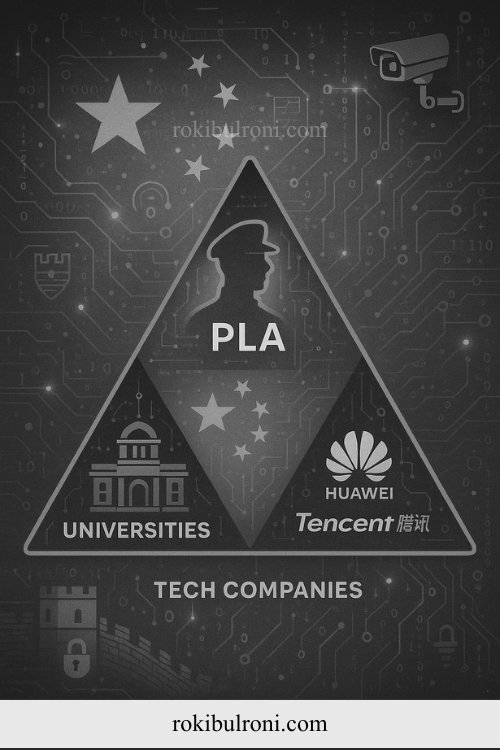
The talent pipeline starts in the classroom. Under the Ministry of Education’s cybersecurity development programs, the government offers full tuition waivers to top-tier students — including elite competitors in national informatics olympiads. In exchange, graduates commit to multi-year placements within the Ministry of State Security (MSS), the People’s Liberation Army (PLA), or state-aligned defense contractors. It is a straightforward deal: your education, in exchange for your skills.
That pipeline flows directly into research. Prestigious institutions like the PLA Information Engineering University, Tsinghua, Beihang, and the National University of Defense Technology (NUDT) operate joint labs alongside commercial security giants such as Qi-An-Xin and Huawei. Students regularly discover and weaponize zero-day vulnerabilities under academic supervision, publishing defensive research while routing the underlying exploitation details straight to state intelligence services.
The most talented researchers get noticed at competitions first. China’s domestic Capture the Flag (CTF) scene — particularly the Tianfu Cup — functions as a national talent filter. Top performers are recruited directly into “innovation studios” and research labs that serve as front organizations or contractors for MSS regional bureaus. Yesterday’s bug bounty champion is systematically transitioned into tomorrow’s state-sponsored intrusion operator.
Completing the loop, private security vendors — among them Shanghai-based I-Soon (Anxun), Boyusec, and Chengdu 404 — act as commercial fronts for espionage work. Leaked internal documents have confirmed that local Public Security Bureaus regularly purchase custom hacking suites, target telemetry, and automated intelligence-gathering platforms from these firms. The result is a self-reinforcing system where academic research, commercial enterprise, and military objectives all pull in the same direction.
Global Hacking Competitions as Recruitment Grounds
Chinese teams now dominate elite exploit competitions, and the implications extend well beyond trophies:
| Competition | Year | Ranking | Chinese Team Achievements |
|---|---|---|---|
| Pwn2Own Vancouver | 2024 | 1st & 2nd | Remote zero-click code execution on Tesla CAN bus & VMware ESXi |
| Tianfu Cup | 2023 | — | 34 unique 0-days against iOS, Windows 11, and Adobe Reader |
| GeekPwn | 2024 | 1st | Deepfake bypass of facial recognition gates |
While competition rules typically require disclosure to affected vendors, China’s vulnerability disclosure laws cut through that expectation. Under the September 2021 Regulations on Security Vulnerabilities of Network Products, domestic researchers must submit discovered vulnerabilities to the Ministry of Industry and Information Technology (MIIT) within 48 hours. In practice, this means the Chinese state receives actionable intelligence on high-severity zero-days before software vendors can even begin writing a patch.
Western export controls limit the direct transfer of offensive cyber tools to China, but Chinese research teams have learned to work around this. By analyzing vendor patch releases and security advisories, they reverse-engineer the underlying vulnerability from the fix itself — effectively converting public defensive updates into offensive weapons.
China’s Long-Term Cyber Strategy
PLA military doctrine has moved well beyond treating cyber attacks as isolated espionage missions. The concept of Integrated Network-Electronic Warfare (INEW) fuses cyber operations with electronic warfare capabilities, aiming to disable communication links, disrupt satellite channels, and compromise command-and-control structures before any physical conflict begins. The goal is to paralyze adversary decision-making from day one.
Running parallel to this is a hybrid influence strategy. The Cyberspace Administration of China (CAC) coordinates large-scale disinformation campaigns while MSS hacking groups breach targeted infrastructure. Networks get infiltrated, data gets exfiltrated, and the stolen material is then weaponized online to shape geopolitical narratives or suppress opposition voices. The offensive and information operations reinforce each other.
What makes attribution particularly difficult is the deliberate blurring of civilian and military activity. Platforms like Gitee host vast libraries of software components — some legitimate open-source work, others containing loaders and obfuscation utilities that appear in state-sponsored malware. The line between civilian open-source development and military offensive research has effectively dissolved. Separating a patriotic freelancer from a PLA operator is incredibly difficult, because in practice, the distinction barely exists.
Training China’s Cyber Army
Inside institutions like NUDT, coursework goes far beyond textbook network security. Academic programs simulate the architectures of foreign critical infrastructure, including Western power grids and transportation hubs. Students are tested on their ability to establish persistent command-and-control (C2) channels and maintain access inside simulated SCADA environments without triggering intrusion detection systems. These are not theoretical exercises.
Beyond the academies, several major commercial tech firms quietly host specialized teams operating behind security clearances from MIIT or the MSS. These groups focus on low-level vulnerability research, baseband protocol fuzzing, and probing niche communications standards in maritime and satellite systems — areas that rarely receive serious defensive attention.
The mobilization structure extends into the private sector as well. Regional governments conduct routine “cyber defense drills” that double as mobilization exercises. Technology startups, telecom operators, and security vendors are expected to commit personnel and infrastructure to support state operations when called upon. Doing business in China’s tech sector increasingly means being integrated into the national digital battle plan whether or not that was ever the intention.
The I-Soon Leaks — A Rare Glimpse Inside
In February 2024, a massive data leak exposed the inner workings of I-Soon (Anxun), a commercial hacker-for-hire firm based in Shanghai with major operations in Chengdu. Internal chat logs, project proposals, product demonstrations, and client lists all spilled into public view, and what they revealed confirmed what investigators had long suspected: private contractors like I-Soon are not peripheral to China’s espionage apparatus — they are deeply embedded in it.
The leaked documents detailed specific pricing models for espionage operations. Local Public Security Bureaus commissioned campaigns targeting regional dissidents, foreign governments, and critical infrastructure. Contracts covered the infiltration of academic and media networks in Hong Kong and neighboring countries, negotiated for sums equivalent to tens of thousands of dollars.
The operational toolsets exposed in the leak were notable for their polish. I-Soon had developed user-friendly management dashboards tracking compromised targets, location data, and hardware specifications. Their tools automated data exfiltration, compromised routers, and hijacked social media sessions including Telegram and X (formerly Twitter). This was not the work of a loose collective of patriotic hackers — it was industrialized espionage with product roadmaps and customer support channels.
Cyber Espionage and Disruption Campaigns
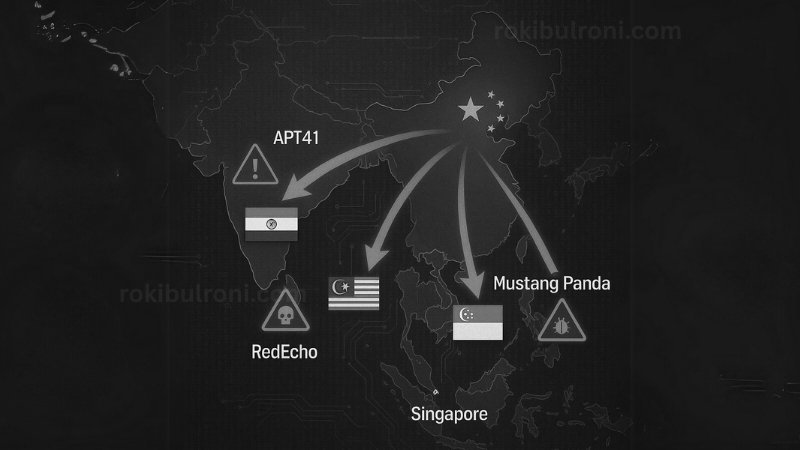
The operational activity attributed to Chinese state-aligned threat groups reflects the breadth of this infrastructure:
| APT Group | Key Capability | Recent ASEAN / Global Activity |
|---|---|---|
| APT41 | Dual criminal-espionage ops; signed drivers | Compromised Indonesian fintech apps (2025) |
| APT10 | Cloud hopping, managed service attacks | Breached Vietnamese government contractors (2024) |
| Mustang Panda | High-volume phishing, PlugX loaders | Targeted Cambodian election observers (2023) |
These groups move fast once inside a network. Techniques like credential dumping via LSASS and domain controller exploitation via DCSync regularly deliver domain administrator access in under an hour. From there, encrypted tunnels are established, and exfiltrated data is often routed through commercial cloud storage services like Alibaba Cloud OSS to blend into legitimate traffic.
But intelligence collection is only part of the objective. Many intrusions targeting oil and gas facilities, transport hubs, and maritime systems involve implants specifically designed to interact with industrial control systems. These logic bombs sit dormant, giving operators the capability to cause physical disruption at a moment of their choosing — typically when geopolitical tension is at its peak.
Case Study: The Volt Typhoon Intrusion in Guam
Microsoft’s May 2023 advisory introduced the security community to Volt Typhoon, a state-linked Chinese threat group with an unusually patient strategy. Their targets were not corporate databases or financial systems. They went after telecommunications, utilities, and transport infrastructure supporting U.S. military bases in Guam.
What distinguished Volt Typhoon was their deliberate avoidance of custom malware. Instead of deploying detectable payloads, they relied entirely on native Windows administrative tools — wmic, vssadmin, netsh — blending their activity into normal administrative logs and bypassing traditional endpoint detection. Living off the Land (LotL) techniques kept them invisible while they methodically mapped network topologies, harvested credentials, and established persistent remote access tunnels.
The behavior pointed to a clear purpose: not intelligence gathering, but pre-positioning. Guam is a critical logistics hub for the entire Indo-Pacific theater. By compromising its communication and power infrastructure, Beijing demonstrated an ability to disrupt Western military response timelines on demand. For neighboring regions sharing similar network equipment and architecture, Volt Typhoon’s work is less a past incident and more a rehearsal.
Facing the Threat — Global and Regional Countermoves
[!IMPORTANT] Collective Response Needed: No single nation can effectively map, attribute, or mitigate China’s highly integrated and decentralized cyber warfare operations. Cooperative intelligence sharing and coordinated defenses are not optional — they are essential.
The response has to be structural, not just reactive. ASEAN CERTs need to move beyond annual tabletop exercises toward real-time, automated threat indicator exchange. The technology already exists; the political will to implement it continuously is what lags behind.
At the global level, intelligence from bodies like NATO and the Five Eyes — including supply-chain forensic methodologies and sandbox detonation data — needs to flow more freely between partners. Catching a compromised software dependency before it propagates globally requires early warning systems that no single organization can run alone.
On the defensive architecture side, zero-trust network segmentation is not a buzzword — it is the practical response to an adversary that already assumes perimeter breach. For a detailed framework, see our guide: Ultimate Guide to Building a SOC and SIEM Career in 2025.
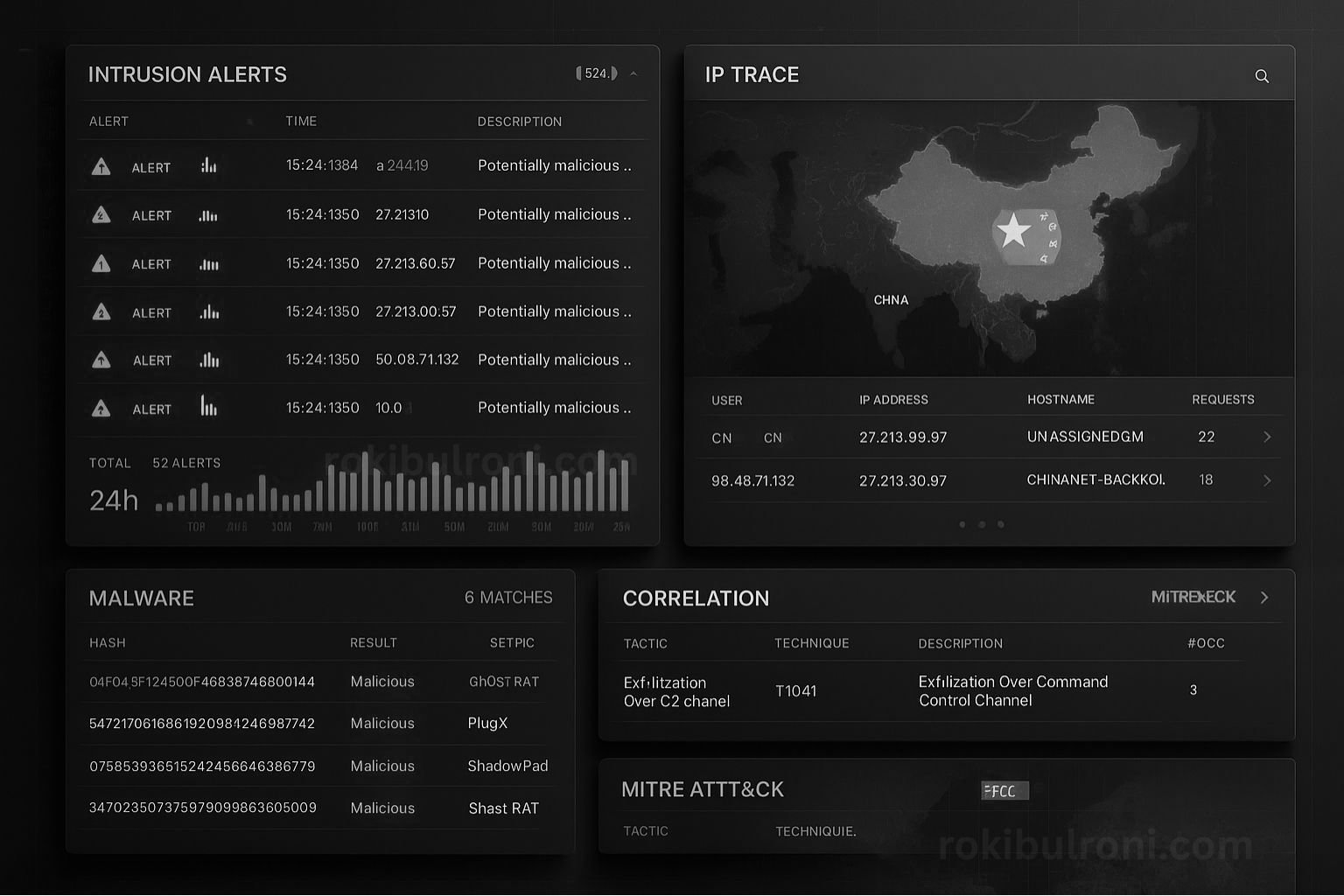
Software supply chain hygiene has become equally critical. Mandating SBOM (Software Bill of Materials) verification for vendors serving critical infrastructure — and cross-referencing dependencies against known malicious IP ranges — should be a baseline expectation, not an advanced requirement.
Precise technical attribution also limits diplomatic deniability. Dedicated malware genealogy labs that can trace code lineage across campaigns make it much harder for state actors to deny involvement. Read more in How Supervised Machine Learning Can Stop Spear-Phishing.
Final Thoughts — Action Items, Not Anxiety
The threat is serious, but it is not undefendable. A few concrete priorities stand out:
Run longer red-team drills. Most SOC exercises test response to immediate, noisy alerts. Simulating 180-day dwell times tests something far more important: whether your team can even detect an attacker who has been quietly present for months.
Harden industrial control protocols. Unauthenticated Modbus/TCP, SMBv1, and legacy protocols on PLCs and HMIs need to go. Encrypted network wrappers and strict boundary controls should be standard practice on any operational technology (OT) network.
Treat the software supply chain like production infrastructure. Cryptographically signed commits, MFA for developers, and automated secret scanning are baseline hygiene. Groups like APT41 actively target CI/CD pipelines, and a compromised build environment is as dangerous as a compromised server.
Build regional threat frameworks. Custom MITRE ATT&CK profiles that document TTPs specific to regional threat actors are far more actionable than generic threat intelligence feeds. The investment in building and maintaining these pays off every time an analyst can correlate a new incident against a known pattern.
Invest in deep technical skills. Hands-on reverse engineering, assembly analysis, and protocol security are more valuable than dashboard certifications when facing adversaries who operate at the zero-day level. This is where training budgets should go.
The next generation of threats — edge-based AI worm propagation, quantum-resistant cryptographic attacks — is already in prototyping stages within the same research labs training today’s state-sponsored operators. If defenders don’t match that systemic investment in technical depth, the gap will only widen.
China’s cyber forces are active on the perimeter right now. Collaborative intelligence, granular attribution, and advanced forensic capability are the only defenses that scale to meet them.