
In March 2025, the security operations center of Pacific Rim Bank discovered a breach that had been sitting unnoticed for hours. An attacker had quietly exfiltrated credentials for the bank’s SWIFT transfer gateway. Forensic analysis traced everything back to a single, highly personalized email disguised as a board-level memo. The sender’s domain passed SPF and DKIM authentication. The message tone was indistinguishable from genuine internal correspondence. Every legacy security filter waved it through — and by the time anyone noticed, $12 million was gone.
This is the uncomfortable reality facing security teams today. Traditional email defenses were built to stop spam at scale — high-volume, low-effort campaigns that leave obvious fingerprints. They were never designed for the kind of bespoke, research-heavy attack that characterizes spear-phishing. Defending against it requires something fundamentally different: systems that learn, adapt, and understand context rather than just match patterns. Supervised machine learning fills that gap in a way that static rules simply cannot.
Why Spear-Phishing Is So Dangerous
What makes spear-phishing so effective is the preparation that goes into it. Attackers typically spend weeks or months profiling their targets — harvesting details from LinkedIn profiles, company press releases, conference talks, and even discarded documents. By the time the email arrives, it can reference real project names, mention colleagues by name, and mirror the exact tone the recipient expects from that sender.
A few specific techniques make these attacks particularly hard to catch:
Hijacked trust is the most insidious. Attackers who intercept an ongoing email thread, or convincingly forge a reply chain, immediately lower the recipient’s guard. The message doesn’t feel like an intrusion — it feels like the conversation continuing.
Micro-targeting keeps the volume low intentionally. Sending to fewer than ten recipients means the campaign never registers as an anomaly in SIEM systems that flag bulk activity. There’s nothing statistical to catch.
Manufactured urgency does the psychological heavy lifting. A message demanding immediate action for a board meeting or executive deadline forces the recipient to act before they think. It’s social engineering, not technical exploitation — and it works.
For teams responsible for phishing attack prevention day-to-day, this combination of psychology and operational stealth demands a fundamentally different approach. You can explore these manipulation tactics in depth in our Social Engineering — Complete Roadmap. Our guide to Building a 24/7 Tier-1 SOC in Malaysia also covers how structured shift design reduces analyst fatigue — another factor attackers actively exploit.
Why Traditional Filters Fail
Conventional secure email gateways (SEGs) operate on static indicators. They scan for known malicious file hashes, blacklisted URLs, suspicious sending IPs, and heuristic red flags like generic trigger phrases or broken HTML formatting. They score sender domains based on age and bulk-mailing behavior. All of this works well against commodity spam.
Against a sophisticated spear-phishing campaign, it fails almost completely. If the attacker registers a fresh, clean domain, writes flawless corporate prose, and crafts a custom payload for this one target, there’s nothing for a signature-based tool to match. The entire attack is designed to look legitimate.
More fundamentally, deterministic rules have no concept of context. They can’t recognize when an email’s writing style deviates from a user’s historical correspondence, or identify that a thread has suddenly changed tone in the middle. That contextual awareness is exactly what adaptive machine learning models are built to provide — and it’s driving a real shift in how leading security teams approach email threat intelligence.
Supervised Machine Learning for Spear-Phishing Detection
Supervised learning is straightforward in concept: you train an algorithm on thousands of emails already labeled as either benign or malicious, and it learns to draw a boundary between the two. Over time, as it sees more examples, the boundary becomes more precise — and more resistant to the subtle evasion tactics attackers use.
A practical pipeline for phishing email classification typically runs through these stages:
- Ingestion — Raw EML or MIME objects are pulled directly from the mail flow.
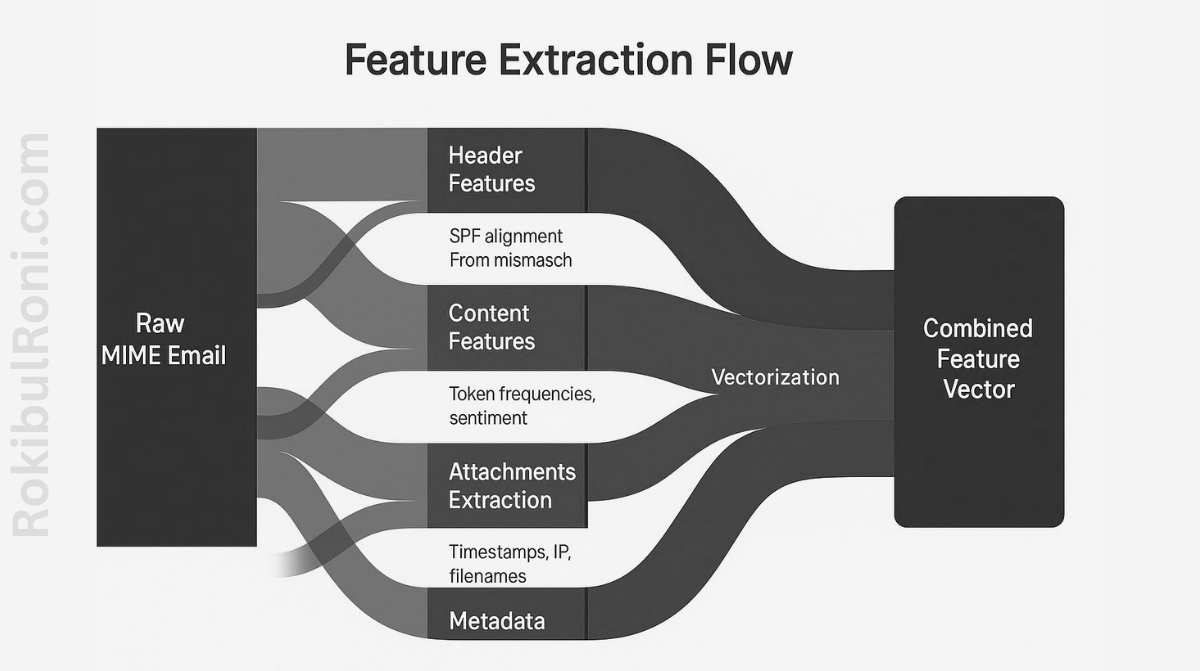
- Feature Extraction — Key signals are identified: header anomalies, lexical patterns in the body, sender-recipient relationship metrics.
- Vectorization — Text and structural data are converted into numerical formats using TF-IDF, one-hot encoding, or dense embeddings.
- Model Training — Classifiers like Random Forest, Support Vector Machines, or gradient boosting models (XGBoost) are trained on the extracted features.
- Validation — Performance is evaluated using k-fold cross-validation and tested against simulated adversarial inputs.
- Deployment — The trained model runs inline or as an enrichment step inside a SIEM pipeline.
The real strength of supervised learning is that it works from ground truth specific to your environment. Every organization has its own history of phishing attempts and legitimate traffic — that data trains models to recognize the indicators that actually matter for your users, not a generic threat profile.
| Model / Algorithm | Primary Strengths | Notable Trade-offs |
|---|---|---|
| Random Forest | Handles mixed data types well; provides clear feature importance metrics out of the box. | Relatively large memory footprint at scale. |
| Linear SVM | Strong margin maximization; highly interpretable weight vectors. | Requires careful hyperparameter tuning. |
| XGBoost | Exceptional predictive accuracy; optimized for fast inference. | Complex ensemble structure needs SHAP or similar for explainability. |
import email
import re
from sklearn.feature_extraction.text import TfidfVectorizer
from sklearn.ensemble import RandomForestClassifier

# Sample raw email data and corresponding labels (1 = Phishing, 0 = Benign)
sample_emails = [
    "Subject: Urgent: Verify your SWIFT credentials\n\nDear team, please verify your SWIFT gateway details immediately on our portal.",
    "Subject: Q3 Project Board Review meeting notes\n\nHi John, here are the minutes from the Q3 project board review meeting. Let me know if you have feedback."
]
labels = [1, 0]

def preprocess(raw_email_str):
    msg = email.message_from_string(raw_email_str)
    subject = msg['Subject'] or ''
    body = ''

    if msg.is_multipart():
        for part in msg.walk():
            if part.get_content_type() == 'text/plain':
                payload = part.get_payload(decode=True)
                if payload:
                    body += payload.decode(errors='ignore')
    else:
        payload = msg.get_payload(decode=True)
        if payload:
            body = payload.decode(errors='ignore')

    cleaned_text = re.sub(r'[^A-Za-z]+', ' ', subject + ' ' + body).lower()
    return cleaned_text

processed_emails = [preprocess(mail) for mail in sample_emails]
vectorizer = TfidfVectorizer(ngram_range=(1, 2), max_features=20000)
X = vectorizer.fit_transform(processed_emails)

classifier = RandomForestClassifier(n_estimators=100, n_jobs=-1, class_weight='balanced', random_state=42)
classifier.fit(X, labels)

print(f"Model successfully trained on {X.shape[0]} samples with {X.shape[1]} features.")
Deploying this architecture as an SMTP mail transfer agent (MTA) sidecar delivers robust threat detection with sub-millisecond latency. Ensemble models routinely achieve F1-scores above 98% on balanced email datasets, and scheduling weekly retraining cycles means the model evolves alongside new social engineering tactics rather than falling behind them. Every feature vector is also logged, giving forensic investigators a clean, auditable record of exactly why a message was flagged.
Feature Engineering and Public Datasets
Raw email content is noisy. The work of transforming unstructured headers and body text into structured, feature-engineered datasets is what allows algorithms to isolate genuine threat signals from the surrounding noise.
| Feature Category | Example Metric / Feature | Cyber Threat Indicator / Rationale |
|---|---|---|
| Header Integrity | Mismatch between From and Return-Path, or SPF/DMARC failures. | Strong indicator of sender spoofing or domain hijacking. |
| Authentication Alignment | DKIM verification status and signature alignment. | BEC and spoofed senders frequently fail DKIM checks. |
| Semantic Analysis | Density of imperative verbs, urgency tokens, monetary cues. | Highlights psychological manipulation and social engineering patterns. |
| HTML Structure | Presence of hidden iFrames, external CSS imports, or input form tags. | Common in credential harvesting portals masquerading as attachments. |
| Behavioral Tone Shift | Sentiment deviation compared to the sender’s historical baseline. | Detects compromised accounts where an attacker is acting with unusual urgency. |
For training and testing, three public corpora are particularly valuable. The Enron Email Dataset — over 500,000 genuine corporate emails — serves as a reliable baseline for benign communication. The Nazario Phishing Corpus provides thousands of labeled historical phishing and spear-phishing examples. PhishTank rounds this out with a real-time, community-maintained feed of active phishing URLs, ideal for enriching URL-based features.
[!TIP] For robust incident response and digital forensics, capture the raw MIME, its extracted feature vector, and the final classification label in a tamper-evident database (SQLite with write-ahead logging works well, or blockchain anchoring for high-compliance environments). This preserves a clean chain of custody for audit purposes.
From Lab to Production: Operational Checklist
Moving a machine learning model from a research notebook into a live mail stream is a real DevSecOps undertaking. Getting it right requires attention to ingestion, lifecycle management, security controls, and feedback loops — all four matter.
Ingestion pipeline hardening starts with capturing incoming mail streams securely, using Postfix’s always_bcc directive or custom Milter protocols. PII should be hashed or anonymized before storage to keep the pipeline compliant.
Model lifecycle governance means committing to a regular retraining schedule — a 30-day cadence managed through MLflow is a common approach. Keep inline inference times low, targeting a p95 latency SLO below 2ms per message so the model doesn’t become a bottleneck in mail delivery.
Security controls around the inference environment itself are easy to overlook. Deploy inference containers with read-only root filesystems to prevent tampering, and enforce signed commits for model configuration updates. The model pipeline is security-critical infrastructure and should be treated as such.
Feedback loops close the improvement cycle. A weekly triage process for false positives and false negatives, reviewed by analysts, continuously feeds high-fidelity labeled examples back into the training pipeline. Without this, even a good model drifts as attackers evolve their tactics.
For containerization and security isolation guidance, our guide on setting up a home web server on Raspberry Pi 5 covers relevant isolation patterns in a practical context.
Evaluating Model Performance: Beyond Basic Accuracy
In a typical corporate mail environment, spear-phishing emails account for less than 0.03% of all inbound traffic. In that kind of heavily imbalanced dataset, standard accuracy is a useless metric — a model that marks every single message as benign would score 99.97% accuracy while completely failing at its job.
Three metrics actually tell you something useful here:
F1-Score balances precision and recall, capturing the trade-off between missed detections and false alarms in a single number. It’s the standard starting point for any email classifier evaluation.
Matthews Correlation Coefficient (MCC) is more robust under class imbalance. It only returns a high score when the model performs well on both classes — benign and malicious — simultaneously. A model that just learns to predict the majority class will score poorly.
Campaign-Level AUROC clusters incoming attempts by payload hash or sender metadata, measuring how well the model catches coordinated attack waves rather than just individual messages in isolation.
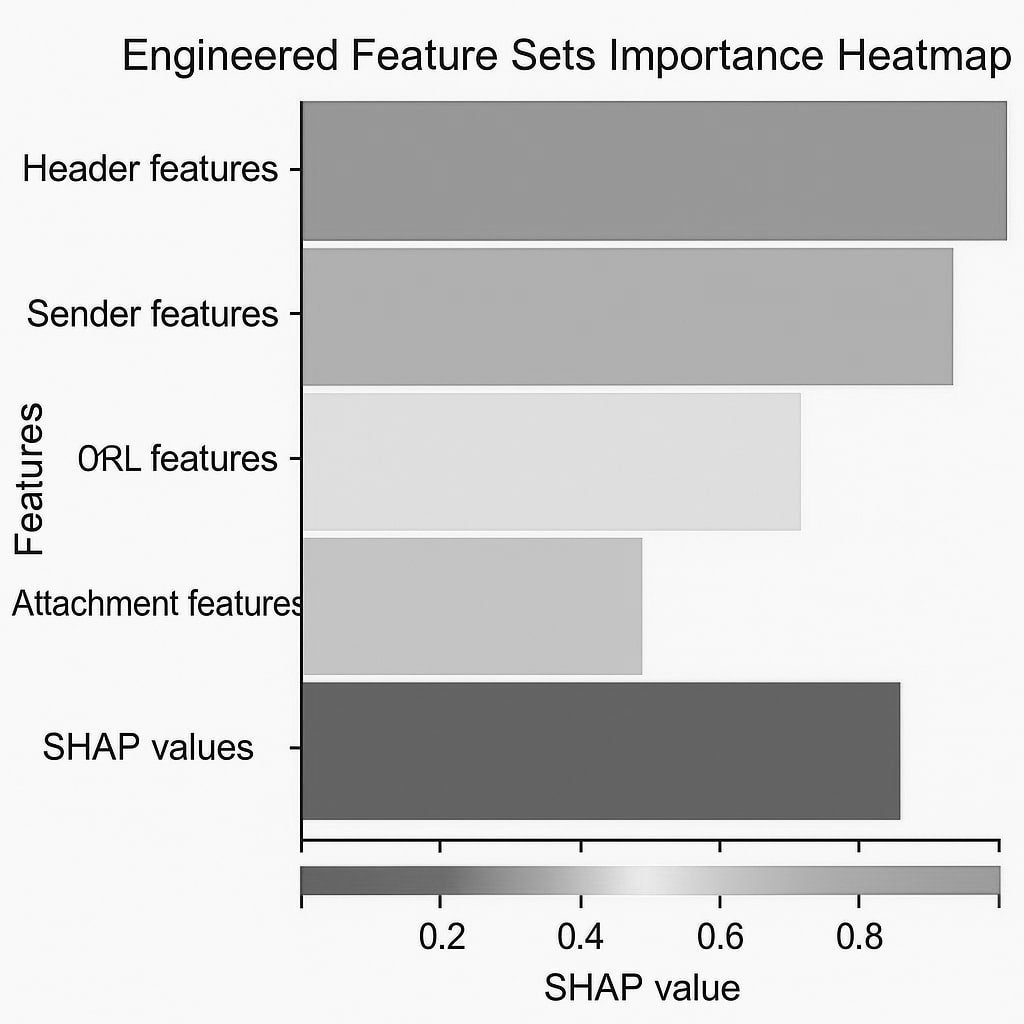
During the post-incident analysis at Pacific Rim Bank, the newly deployed Random Forest model achieved a 0.96 F1-score. The legacy rule-based gateway it replaced had managed 0.71 on the same traffic. SHAP (SHapley Additive exPlanations) values also allowed analysts to trace exactly which features — anomalous sender patterns, urgency indicators like “per your urgent request” — drove each detection, providing solid evidence for forensic documentation.
Open-Source Tooling for Your Security Pipeline
| Operational Area | Recommended Tool | Core Value / Practical Notes |
|---|---|---|
| Feature Extraction | Apache Tika | Parses attachments across 1,400+ file formats. |
| Text Vectorization | Scikit-learn (TF-IDF) | Python-native, well-optimized, ideal for baseline tokenization. |
| Model Training | XGBoost / LightGBM | Strong performance on large, sparse datasets with low inference latency. |
| ML Pipeline Ops | MLflow | Tracks parameters, registers models, handles version control. |
| Threat Intelligence | PhishTank API | Real-time URL feeds for validating incoming links. |
For detailed instructions on setting up a self-hosted container environment to run these models, see our Portainer Stack Tutorial.
Deploying Models in Modern SOCs
Integrating an ML classifier directly behind the Mail Transfer Agent allows security teams to catch spear-phishing in real time rather than after the fact. A message scoring a risk index at or above 0.80 can automatically trigger a SOAR playbook:
- Ticket Creation — Open a high-priority incident in JIRA or ServiceNow immediately.
- Retroactive Hunting — Query the mailbox database for identical or similar messages delivered in the past 30 days and purge them.
- Intel Sharing — Export malicious IPs, domains, and file hashes to the threat intelligence platform automatically.
Because supervised models provide explainable outputs — highlighting the specific features that triggered each classification — SOC analysts can verify alerts without guessing. They see exactly why a message was flagged. That transparency is critical not just for analyst efficiency, but for compliance and audit reporting as well.
If you’re building a career in this space, our Ultimate Guide to SOC & SIEM Careers covers the full landscape. We also break down the platform differences in SIEM vs. SOAR: Which One Do You Need?.
MITRE ATT&CK Mapping & Regulatory Compliance
Aligning ML-based detection with standard frameworks ensures your controls hold up under audit. This defense directly maps to MITRE ATT&CK Technique T1566.002 (Spearphishing Link) and T1566.001 (Spearphishing Attachment).
On the compliance side, adaptive classification satisfies requirements under ISO/IEC 27001 (Control A.5.10 — Information Security Incident Management) and regional standards like the MAS TRM Guidelines (Section 9.1.4) from the Monetary Authority of Singapore. Having an explainable, documented model pipeline makes the difference between a control that satisfies an auditor and one that needs months of remediation work.
Next-Generation Research in Email Security
The field is moving fast. A few research directions worth watching:
Graph Neural Networks treat organizational communication as a network graph. Node embeddings capture the relationships and communication frequency between senders and recipients, building a deep baseline of relational trust that’s very hard for an attacker to fake without compromising an existing account.
Contrastive learning pre-trains models on large unlabeled email corpora to learn general language representations, then fine-tunes them on a small set of high-fidelity labeled spear-phishing examples. This approach gets strong performance even when labeled attack samples are limited.
Federated learning makes it possible to share knowledge about emerging threats across organizations — even across industries like finance and healthcare — without exposing any underlying email content. Shared threat intelligence without shared data is a genuinely useful capability.
Edge inference engines port scoring models into lightweight, Rust-based runtimes inside the MTA itself. This minimizes latency and enables immediate quarantine before a message ever reaches the recipient’s inbox.
Progress in this space demands a genuine fusion of data science, threat intelligence, and compliance thinking — which is exactly what modern email security requires.
Retrospective Case Study: Pacific Rim Bank
To make the value of inline ML classification concrete, here’s how the incident timeline played out at Pacific Rim Bank after the new model was deployed:
| Time (UTC+8) | Incident Event | Active Detection / Security Layer |
|---|---|---|
| 09:02 AM | A highly targeted email titled “Q1 Governance Metrics” is delivered. | Mail Transfer Agent (MTA) |
| 09:04 AM | The inline ML classifier scores the message at 0.87 risk and routes it to quarantine. | Supervised ML Model |
| 09:05 AM | An automated SOAR playbook executes, running threat intelligence checks. | SOAR Integration |
| 09:12 AM | A security analyst reviews the quarantined mail; the embedded URL is confirmed as a credential harvester. | Analyst / Malware Sandbox |
| 09:18 AM | The SOC runs a retroactive mailbox query and confirms zero delivery across the organization. | SIEM / Log Analytics |
| 10:44 AM | A secondary payload delivery attempt is blocked at the proxy; audit logs are secured. | Web Proxy / Digital Forensics |
Three things made the difference. The absence of standard X-Mailer headers — typical of automated exploitation frameworks — pushed the anomaly score up significantly. An unusual attachment format deviation (the sender had historically shared only .xlsx files; this message attempted to deliver a .docx) was caught by the feature set. And the detection itself was fed back into the weekly retraining cycle, improving baseline recall by an additional 0.7% across the next training run.
In 2023, before the model was deployed, a nearly identical lure sailed through legacy filters and remained active for 36 hours. The ROI on adaptive machine learning here is not hypothetical — it shows up directly in the incident logs.
Summary: Staying Ahead of the Threat
Supervised machine learning is no longer an experimental safeguard. It’s a core requirement for enterprise email defense. The combination of carefully engineered features, ground-truth training data, and continuous retraining cycles produces classifiers that adapt dynamically to new threats — something static rule sets fundamentally cannot do.
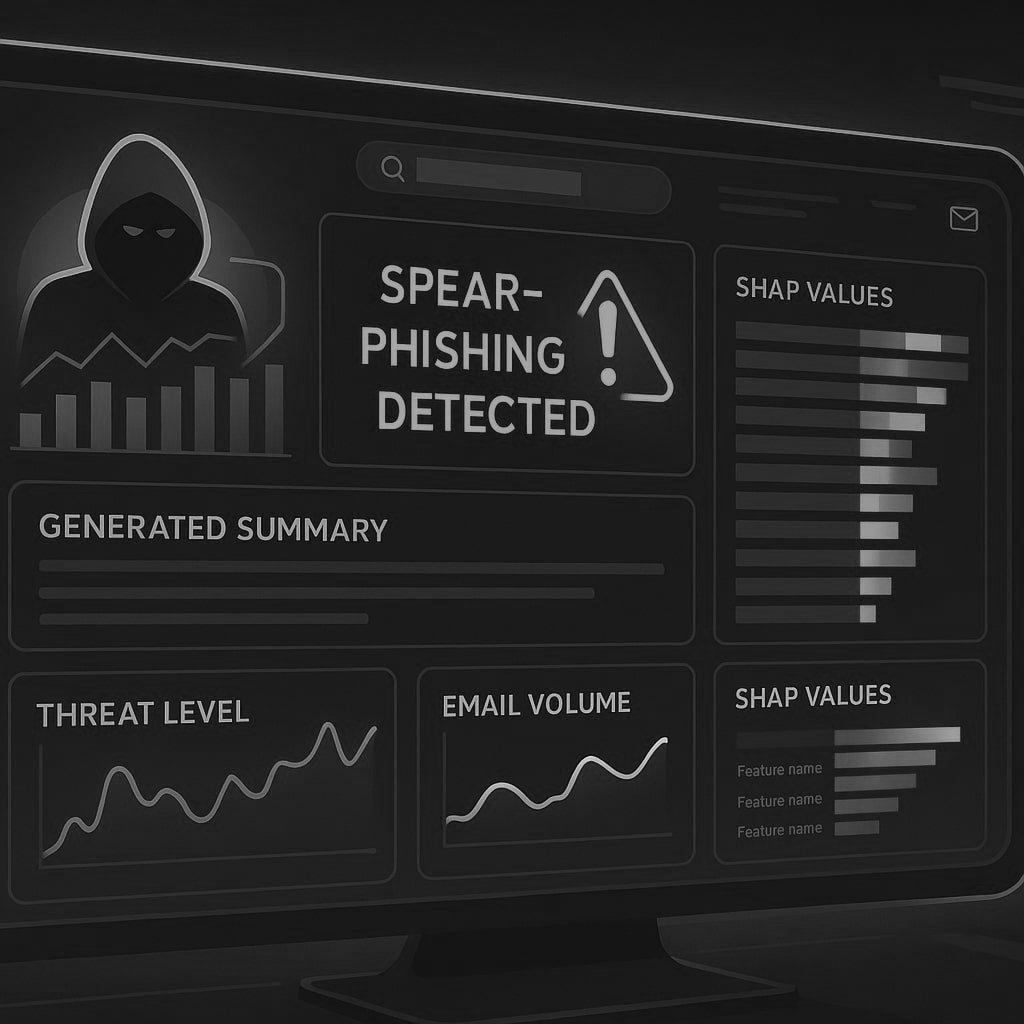
The next iterations will push further: LLM-based summarization to distill email intent and accelerate triage, federated learning for secure cross-organization threat sharing, and explainable AI dashboards that present model decisions in a format analysts can act on without guessing.
In cybersecurity, standing still means falling behind. Spear-phishing is getting more sophisticated, not less. Adaptive, data-driven email defense is the most effective way to stay ahead of it.
Further Reading
- AI in Cybersecurity: Revolutionizing Threat Detection and Response
- Why SMS 2FA Is No Longer Safe
- Self-Hosting Lemmy: A Secure, Decentralized Social Media Platform