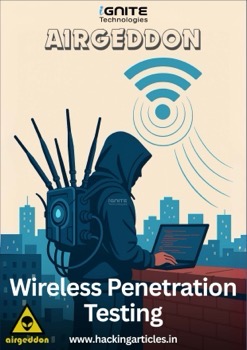
“Airgeddon enables the capture of WPA/WPA2 and PMKID handshakes in order to launch brute-force assaults on Wi-Fi password keys. It also aids in the creation of fictitious Access Points for launching Evil Twin Attacks by luring clients into the captive portal.”
Wireless network penetration testing is one of the most viscerally dangerous disciplines in offensive security. Unlike remote web exploits, it requires physical proximity, specialized hardware, and an intimate understanding of radio frequency (RF) protocols. Wireless Penetration Testing: Airgeddon provides an end-to-end operational guide to the Airgeddon framework—a powerful, menu-driven Bash script that consolidates dozens of complex wireless exploitation tools into a single, unified execution environment.
Transitioning to Monitor Mode
Before any wireless attack can begin, the operator must transition their wireless adapter from standard Managed mode into Monitor mode. The guide meticulously walks through this crucial step, explaining how Monitor mode enables the wireless card to passively capture all radio packets traversing a given channel, rather than only those addressed to it. Without this transition, handshake capture is physically impossible.
Capturing the Four-Way Handshake
The primary attack vector in WPA/WPA2 exploitation is intercepting the cryptographic Four-Way Handshake between a client device and the Access Point. The guide provides two distinct pathways:
- Passive Capture: Waiting silently for a legitimate client to naturally authenticate.
- Deauthentication Attack: Aggressively forcing clients to disconnect from the network by flooding them with forged deauthentication frames, compelling them to re-authenticate and exposing the handshake in real-time.
Offline Cracking Arsenal
Once the .cap handshake file is captured, the guide integrates seamlessly into offline password recovery. It demonstrates passing the captured file through three fundamentally different cracking engines:
- Aircrack-ng Dictionary Attack: Iterating massive wordlists directly against the captured handshake.
- Aircrack-ng Brute Force: Generating exhaustive character permutations via
crunchand piping them live into the cracking engine. - Hashcat Rule-Based Attack: Leveraging GPU-accelerated processing and intelligent mutation rules (appending numbers, toggling case, inserting special characters) to crack complex passphrases that dictionary attacks miss.
The Evil Twin: Social Engineering the Airwaves
The most devastating attack methodology covered is the Evil Twin. Instead of cracking the password mathematically, the guide demonstrates deploying a rogue Access Point that perfectly mimics the target network. It broadcasts a stronger signal, forces client devices to associate to it, and presents a highly convincing captive portal webpage requesting the Wi-Fi password—which the victim voluntarily submits.
Who Is This Book REALLY For?
- Wireless Penetration Testers: Airgeddon dramatically simplifies complex multi-tool workflows into a single interactive session, making it indispensable for rapid wireless assessments.
- Physical Red Team Operators: Understanding how to deploy Evil Twin infrastructure from a concealed position provides a critical social engineering vector during on-site assessments.
- Network Administrators: A powerful demonstration of why WPA2-Enterprise with RADIUS authentication is fundamentally more resilient than Pre-Shared Key (PSK) deployments.
The Bottom Line
Wireless Penetration Testing: Airgeddon consolidates the full wireless kill chain into a single, terrifyingly effective framework. From passive reconnaissance to credential harvesting, it proves that nearby Wi-Fi networks are never truly safe.