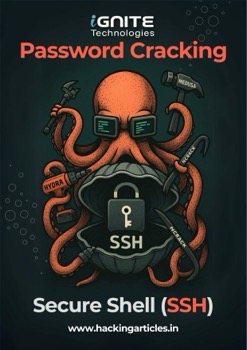
“SSH brute-force attacks remain one of the most prevalent initial access vectors. Unlike legacy protocols, SSH’s encrypted channel presents unique challenges and opportunities for credential-based attacks.”
Secure Shell (SSH) is the backbone of remote server administration. Because the protocol strictly enforces cryptographic encapsulation, an attacker correctly positioned on the network cannot simply sniff passwords in transit as they can with FTP or Telnet. To break SSH, an attacker must break the authentication mechanism directly. Password Cracking: SSH provides the operational blueprints to execute massive, dictionary-backed brute-force attacks against administrative infrastructure.
Navigating the Cryptographic Barrier
Administrators falsely believe that because a service is encrypted, it is impenetrable. The guide shatters this assumption by treating the encrypted port purely as an authentication gateway.
Mapping its methodology strictly against the MITRE ATT&CK framework (T1110.001 – Brute Force: Password Guessing), it instructs the operator to perform surgical Nmap enumerations (-p 22 -sV) to identify the exact OpenSSH version running, tailoring the following attack matrix to the specific daemon configuration.
Multi-Framework Execution
Execution is the core focus of the manual. Brute-forcing SSH is notoriously taxing on the attacker’s CPU due to the cryptographic handshakes required for every single login attempt. Therefore, selecting the correct engine is critical.
The text details the explicit command-line structure for dominating port 22 across multiple platforms:
- Hydra & Medusa: Tuning parallel connection threads to maximize password attempts per second without crashing the SSH daemon.
- NetExec (nxc): Leveraging modern tooling to spray a single, highly probable password across an entire
/24subnet of SSH servers simultaneously. - Ncrack & Metasploit: Utilizing modular frameworks to intelligently manage connection timeouts and adaptive throttling against sophisticated SSH implementations.
- BruteSpray: Executing fully autonomous, large-scale credential spraying pipelines fed directly by Nmap XML discovery scans.
Defensive Thresholds
The manual ensures it maintains parity by offering robust defensive logic. It explains that because SSH cannot be sniffed, the only viable defense against a relentless Hydra attack is active threshold monitoring. It details exactly why deploying behavioral blocking daemons such as Fail2Ban or SSHGuard is absolutely mandatory to permanently ban IP addresses that generate high-velocity authentication failures.
Who Is This Book REALLY For?
- Penetration Testers: A dedicated reference manual ensuring that when an entire DMZ of Linux servers is discovered, the tester knows the exact syntax to begin cracking the authentication gateways concurrently.
- Linux System Administrators: Understanding how trivially easy it is for an attacker to launch an automated Ncrack or BruteSpray campaign against a public-facing SSH port reinforces the absolute necessity of disabling password authentication in favor of strict RSA/Ed25519 Key-Based Authentication.
- Blue Teams: Providing insight into how modular brute-forcing engines manipulate connection threads, allowing defenders to better tune their NIDS (Suricata/Zeek) alerting thresholds.
The Bottom Line
Password Cracking: SSH demonstrates that encryption only protects data in transit; it does nothing to protect a weak password. It is a definitive guide to aggressively exploiting human negligence at the administrative level.