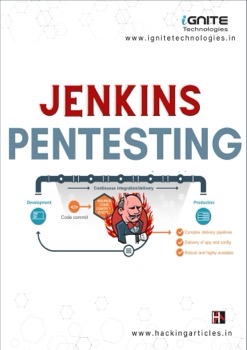
“Jenkins is essential for continuous integration (CI) and continuous delivery (CD). Built on Java, Jenkins utilizes a scripting platform to automate tasks. If unsecured, this powerful automation capability allows attackers to execute arbitrary system commands natively.”
The adoption of Continuous Integration / Continuous Deployment (CI/CD) pipelines has vastly accelerated software release cycles, but it has also centralized massive execution power into single control planes. Jenkins Penetration Testing zeroes in on this vulnerability. It is exceptionally dangerous because a compromised Jenkins server does not just yield a single endpoint—it grants an attacker the ability to inject malicious code into the organization’s entire production codebase.
Infrastructure and Configuration
To understand how Jenkins is compromised, the manual instructs the reader on how it is built. It details a ground-up installation on an Ubuntu host, managing the OpenJDK Java dependencies, configuring the daemon, and crucially, highlighting the initial administrative setup.
The text points out the first major vulnerability in weak Jenkins deployments: obtaining the incredibly sensitive initialAdminPassword directly from the /var/lib/jenkins/secrets/ directory if standard file permissions are mismanaged on the host operating system.
The Attack Surface: Groovy Script Consoles
Once administrative access is obtained—whether through default credential brute-forcing on port 8080 or via an exposed initialAdminPassword—the guide strictly focuses on native exploitation.
Unlike targeting highly secured web applications, Jenkins is literally designed to run scripts. The manual walks attackers through leveraging the built-in Groovy Script Console. By injecting standard Java payload strings into this administrative console, an attacker forces Jenkins to natively spawn a reverse TCP shell (/bin/bash -i) back to the Kali Linux attacking infrastructure.
Multi-Vector Exploitation
The guide expands beyond native manual exploitation, demonstrating how to fully integrate the attack into the Metasploit Framework. It outlines how automated modules can systematically sweep enterprise subnets for exposed Jenkins instances, brute-force administrative credentials, and deploy Java-based Meterpreter payloads for structured post-exploitation.
Who Is This Book REALLY For?
- Cloud Security Engineers: A stark reminder that CI/CD environments are Tier-0 infrastructure. If Jenkins is exposed to the internet with weak credentials, the entire software supply chain is mathematically compromised.
- Red Team Operators: Providing the exact Groovy and Java syntax required to transition from application-level access into a highly privileged, persistent reverse shell on the underlying host network.
- DevOps Teams: Highlighting why strict network segmentation and avoiding default configurations during automated server spin-ups are non-negotiable standards.
The Bottom Line
Jenkins Penetration Testing strips away the marketing jargon surrounding “automated software delivery” and treats Jenkins for what it is to an attacker: a massive, internet-facing Remote Code Execution (RCE) engine.