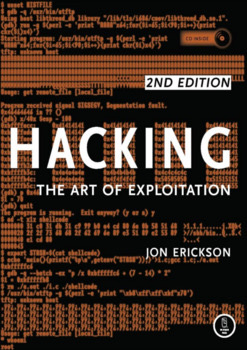
Let me be entirely upfront: if you are looking for a book that shows you which buttons to click in MetaSploit or how to run an automated vulnerability scanner, close this tab immediately. Jon Erickson’s Hacking: The Art of Exploitation is not a user manual for pre-packaged tools; it is a brutal, beautiful, and profound autopsy of how software actually works at the machine level.
In an industry overflowing with high-level abstractions, this book violently drags you down to the bare metal. It forces you to confront the reality that to be a true hacker—not just a tool user, but someone who understands the intrinsic physics of a system—you have to speak its native language. This book is the Rosetta Stone for translating abstract vulnerability concepts into raw, weaponized C code and assembly.
The Shift in Thinking
The paradigm shift this book forces on you is immense. Before reading it, a “buffer overflow” was just a conceptual vulnerability I understood in theory. After reading it, a buffer overflow became a tangible manipulation of the stack frame. Erickson doesn’t just tell you that you can overwrite a return address; he walks you through firing up the GNU Debugger (GDB), setting breakpoints, inspecting CPU registers, and manually calculating the exact byte offset needed to slide down a NOP sled and hit your custom shellcode.
The book defines hacking not as a malicious act, but as a creative and intellectual pursuit—an “art form” focused on elegance and finding unintended uses for a system’s rigid rules. It completely reframes the relationship between high-level C programming and the resulting machine code, illustrating how a beautifully designed (but insecure) C function translates into a catastrophic memory corruption flaw.
Real-World Relevance
You might look at the 2008 publication date and immediately dismiss it. That would be a massive mistake. While the specific OS environments and basic defense mechanisms (like older ASLR implementations) have evolved, the underlying physics of memory management, the stack, and the heap remain identical.
The hands-on approach is what cements its relevance. By utilizing the included LiveCD environment (or setting up your own modern equivalent Linux VM), you are forced to write the C code, compile it with GCC, analyze the binary, and write the exploit. The chapters on Socket Programming and Shellcode Development are particularly timeless. Learning how to write arbitrary shellcode to spawn a listener, bind to a port, and execute /bin/sh using raw system calls strips away the mystery of modern payloads. It teaches you how tools like MetaSploit build their payloads under the hood.
Who Is This Book REALLY For?
- Aspiring Exploit Developers & Red Teamers: If your goal is zero-day research, writing custom exploits, or deep-dive reverse engineering, this book is arguably the most important foundational text you can read.
- Security Engineers & CTOs: If you need to understand why memory-safe languages are critical and exactly how legacy C/C++ applications fall apart under pressure.
- Those Who Refuse to Be Script Kiddies: If you have an insatiable intellectual curiosity to understand the absolute lowest levels of systems architecture and network protocols.
Who Is This NOT For?
- Web Application Hackers: If you are focused strictly on XSS, SQLi, or API vulnerabilities, this book will be of little use to you. It contains virtually zero web content.
- The Faint of Heart: Let’s be honest, this is not an easy read. If you hate programming, fear assembly language, and break out in hives at the sight of a GDB prompt, this book will ruin your weekend.
- Immediate Gratification Seekers: You have to put the work in. You must write the code, read the hex dumps, and fail multiple times before the exploits work.
The Honest Drawbacks
The drawbacks are directly tied to its age and depth. Because it was published in 2008, you’ll be reading about outdated specifics like WEP wireless cracking (which is basically a museum exhibit now) and bypassing older, simpler implementations of ASLR and non-executable stacks. Modern exploit development against Windows 11 or hardened Linux kernels requires bypassing layers of mitigations (like advanced ROP chains, PAC, and CET) that are far beyond the scope of this book. It is a foundational text, not the finish line.
The Bottom Line
Hacking: The Art of Exploitation remains the ultimate crucible for anyone serious about offensive security. It will punish you, it will confuse you, and ultimately, it will completely rewire how you look at computer memory.
It is the difference between knowing how to drive a car and knowing how to build the engine block from scratch. Read it, suffer through the C code, and emerge with a profound understanding of the art of the exploit.