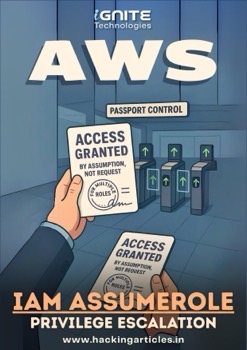
“Role assumption helps follow the principle of least privilege… However, privilege escalation via role assumption is a scenario where a user with limited IAM permissions can gain elevated access to resources using a misconfigured IAM role.”
Identity and Access Management (IAM) is often described as the true perimeter of the cloud. In traditional networks, violating perimeters meant pivoting through firewalls and routers; in AWS, it means abusing authorization matrices. This guide targets one of the most critical, devastating, and common attack vectors in modern cloud environments: exploiting the sts:AssumeRole mechanism to escalate privileges.
Shifting Focus to Trust Policies
When configuring AWS environments, architects frequently obsess over Permissions Policies (what a role is allowed to do) while completely ignoring Trust Policies (who is legitimately allowed to assume that role). This document brilliantly capitalizes on this oversight.
It walks the reader through exactly how misconfigurations in the Trust Policy allow low-privileged IAM users—who were only ever intended to have read-only access—to pivot into high-privilege administrative roles.
Building and Breaking the Environment
Rather than dealing solely in hypotheticals, this guide heavily emphasizes hands-on infrastructure. The first half of the material serves as an intricate lab build-out manual. It teaches you how to intentionally deploy a vulnerable environment consisting of targeted, low-privilege IAM users mapped against highly permissive roles. This architectural phase is incredibly beneficial because it forces you to understand exactly what a vulnerable configuration looks like from the AWS Console perspective before you ever attempt to attack it.
The Attack Methodology
Once the environment is live, the text transitions aggressively into enumeration and exploitation. It moves from using native commands in the AWS CLI to deploying automated third-party tools like the Python-based enumerate-iam script to rapidly identify assumption relationships.
The exploitation phase clearly demonstrates how an attacker requests temporary, powerful security credentials via the AWS Security Token Service (STS) and successfully hijacks administrative control—eventually allowing unauthorized interaction with normally restricted services like sensitive S3 buckets.
Who Is This Guide REALLY For?
- Cloud Penetration Testers: This is an absolute necessity.
AssumeRoleescalation is one of the quickest paths to full cloud account takeover. - AWS Administrators & DevSecOps Teams: Understanding how enumeration scripts parse your IAM topology is critical to correctly securing trust policies and preventing lateral movement.
- Security Analysts: The methodologies explained here outline exactly the type of STS usage spikes and abnormal IAM actions that SOCs should be monitoring for within CloudTrail logs.
The Bottom Line
This is not a high-level overview of AWS security; it is a tactical strike manual focused on a single, high-impact vulnerability. By bridging the gap between how an environment is misconfigured and how a Red Team systematically exploits that oversight, this reference serves as a profound technical lesson in enforcing true least-privilege computing in the cloud.