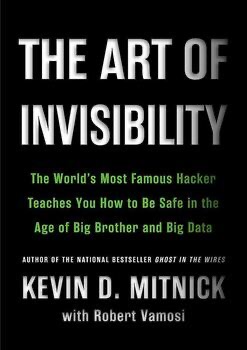
“Do you value convenience over security?”
I thought I did, until this book made me realize I never actually understood the trade-off I was making.
Most people walk through their digital lives convinced they have “nothing to hide.” I was one of them. The Art of Invisibility does not argue with that belief - it demolishes it, calmly and methodically, by showing you exactly how much of your life is already visible to people you have never met and never consented to share with.
Why This Book Matters
Kevin Mitnick was not a security researcher who studied breaches from the outside. He was the breach. He spent years as the FBI’s Most Wanted Hacker - not for money, not for ideology, but because he was genuinely curious about how systems and people could be manipulated. After serving his time, he flipped sides and built a consulting firm that has never failed to break into a client’s systems. Every single engagement. 100% success rate.
That is not a sales pitch. That is the reason you should listen to what this man has to say about your privacy.
When someone who has personally exploited the exact vulnerabilities he is warning you about sits down and writes a book telling you why you should be worried - you should probably read it.
What This Book Will Do to You
I want to be honest: this book will make you uncomfortable. Not in a “thriller novel” way - in a slow-burning, creeping realization way. Mitnick walks you through how your phone is a tracking device broadcasting your location every second. How your email provider reads your messages before you do. How a photo you posted on social media contains hidden metadata that pinpoints the exact GPS coordinates of where you were standing when you took it.
He does not just tell you these things. He shows you - pulling someone’s Social Security number, birth city, and home address history in minutes using publicly available databases. The magic trick analogy he uses early on stayed with me long after I finished the book: objects do not disappear, they are simply hidden from plain sight. Your personal data is exactly the same. It has not vanished. You just cannot see who is looking at it.
The chapters on social engineering hit the hardest. Mitnick’s central argument is devastating in its simplicity: the fastest way into any system is not through code - it is through people. Firewalls can be patched, encryption can be strengthened, but the human instinct to trust, to be helpful, to not question authority - that cannot be patched. He proves this with his own stories of talking his way into Motorola’s proprietary source code, manipulating phone company employees, and watching organizations with million-dollar security budgets get breached because someone held a door open for a stranger carrying a pizza box.
The Real-World Stories That Stay With You
What separates this book from every other privacy guide is the storytelling. Mitnick does not lecture - he narrates. The Edward Snowden chapter reads like a spy thriller: how Snowden established encrypted communication with journalist Laura Poitras using Tor, PGP key exchanges through trusted intermediaries, and anonymous remailers - all while under potential surveillance by the most powerful intelligence apparatus on the planet. It is a masterclass in operational security told through actual events.
The Silk Road case study is equally gripping. Ross Ulbricht spent years building the most sophisticated anonymous marketplace on the dark web, and he was ultimately caught because of one small mistake - mixing a real email address with an anonymous handle. One slip. Years of careful anonymity, unraveled by a single moment of carelessness. That story alone should convince anyone that privacy is not a tool you install once but a discipline you practice every day.
And the connected devices chapters have aged frighteningly well. In 2017, Mitnick was warning about smart TVs recording conversations, fitness trackers enabling constant surveillance, and connected cars being remotely hijacked. In 2026, all three of those warnings are just… the news.
Who Should Read This
If you have ever said “I have nothing to hide”, read this book. Not because you are wrong about your intentions, but because you are wrong about the question. The issue was never about what you have to hide. It is about who gets to decide what matters - you, or the companies and governments collecting your data without meaningful consent.
If you work in cybersecurity, read this book. Not for the specific tool recommendations - some have aged, and you probably already know the current alternatives. Read it because Mitnick thinks like an attacker in a way that most security professionals never will, and his perspective on the human element will sharpen your own defensive thinking.
If you are a parent in 2026, read this book. Your children are growing up in a world where every click, search, and conversation could be logged and analyzed indefinitely. This book gives you the vocabulary and understanding to actually protect them, rather than relying on parental controls that a curious thirteen-year-old can bypass in twenty minutes.
If you are simply curious about how the digital world actually works beneath the glossy interfaces and “we value your privacy” banners, read this book. Mitnick writes clearly, without jargon, and with the kind of directness that only comes from someone who has nothing left to prove.
What It Will Not Do
I will not pretend this book is perfect. Some tool recommendations are dated - Ghostery over uBlock Origin, specific 2G vulnerability details that have been patched. The Bitcoin anonymization advice predates modern blockchain analytics that have made basic tumbling far less effective. And in 2026, AI-powered social engineering has amplified the threats Mitnick describes by an order of magnitude he could only hint at.
But here is the thing - the tools were never the point. The principles are: layered defense, operational compartmentalization, healthy skepticism, and the understanding that metadata often reveals more about you than the content of your messages ever could. Those principles have not aged a day.
Not every reader needs the Chapter 16 anonymous-laptop-running-Tails-funded-by-laundered-Bitcoin setup. But every single person connected to the Internet needs the first five chapters. That is not an exaggeration.
The Last Word
Kevin Mitnick passed away in July 2023. This book remains his most important contribution to the general public - more important than his consulting work, more important than his speaking career, more important than the legend. Because the legend was about one man’s ability to breach systems. This book is about giving everyone else the knowledge to protect themselves.
After reading it, I covered my webcam. I switched to Signal. I started reading privacy policies instead of clicking “Accept.” Small changes, maybe. But I made them because I finally understood why they mattered - not because someone told me to be afraid, but because someone showed me exactly what I had been giving away for free.
That is the kind of book this is. It does not sell you fear. It hands you awareness, and trusts you to decide what to do with it.