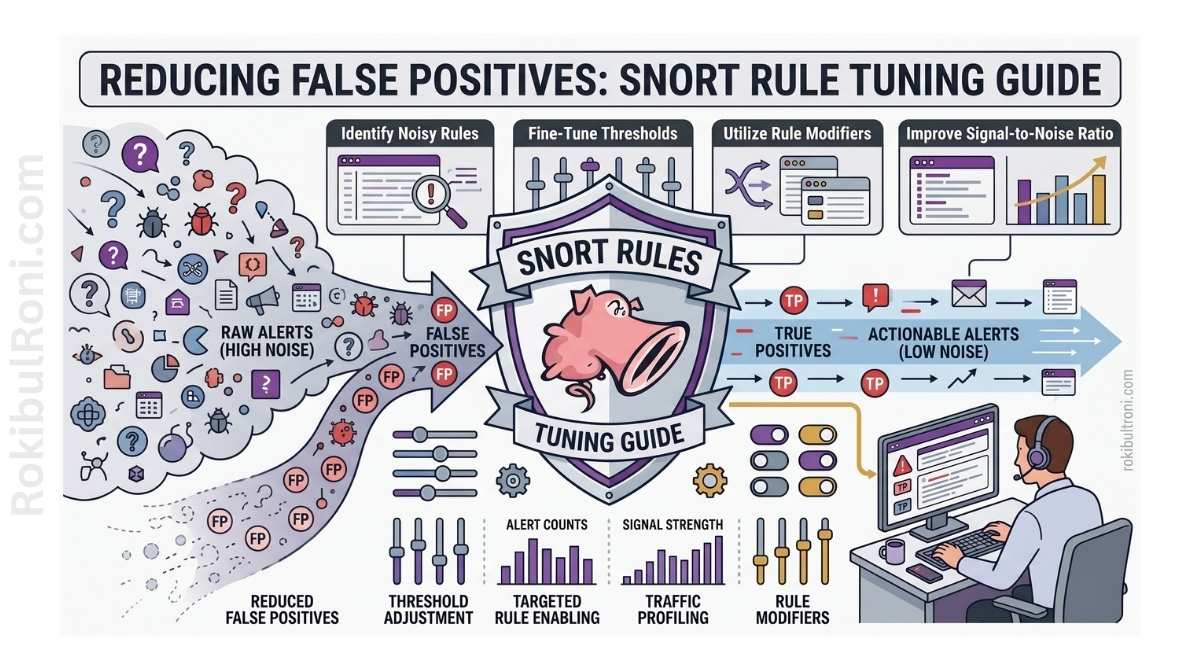
Here’s a hard truth about IDS deployments: an IDS that fires on everything effectively fires on nothing. When analysts are buried under hundreds of low-value alerts every shift, the genuinely dangerous ones get lost in the noise. That’s not a detection problem — it’s a tuning problem.
SNORT rule tuning isn’t about silencing your IDS. It’s about improving signal quality so your SOC spends time on alerts that actually matter. The goal is always the same: fewer false positives without creating blind spots where real threats can hide.
Building a practical SNORT tuning program
Getting tuning right takes discipline. It’s an ongoing engineering process, not something you do once and forget. Here’s how to approach it the right way.
Why tuning matters more than most teams realise
The consequences of a poorly tuned IDS compound over time. Analysts stop trusting the alert queue. Triage times stretch. Real incidents start slipping past teams who’ve learned to pattern-match noise instead of investigating. By the time leadership notices, the detection program has quietly degraded.
Good tuning delivers concrete operational benefits:
- Analysts spend time on alerts worth investigating
- Triage decisions happen faster and with more confidence
- Escalation quality improves because the signal is cleaner
- Detection engineering becomes measurable rather than guesswork
- Visibility is preserved where it actually matters — on critical assets and high-risk zones
The upstream effect is significant. A well-tuned IDS makes every downstream process better.
The visibility trade-off you need to understand
One of the most common mistakes teams make is solving the noise problem by disabling rules entirely. It feels like progress — the alert queue shrinks — but the long-term cost can be serious coverage loss.
| Tuning Choice | Short-Term Effect | Long-Term Risk | Better Alternative |
|---|---|---|---|
| Disable entire rule category | Immediate alert drop | Loss of attack-surface coverage | Threshold tuning + context filtering |
| Broad suppression by source range | Fewer repeated alerts | Masks compromised internal hosts | Narrow suppression with expiration dates |
| Ignore low severity globally | Reduces queue size | Misses chained low-to-high kill paths | Risk-based correlation and escalation rules |
| Keep all defaults unchanged | Preserves raw visibility | Analyst burnout and missed true positives | Structured baseline and phased tuning |
The right target isn’t “fewer alerts.” It’s “better alerts.” Every tuning decision should be measured against that standard.
Know your environment before you touch anything
Tuning without environmental context is how you accidentally blind yourself. Before adjusting a single threshold or writing a suppression, make sure you have clear answers to the following:
Context you need to gather:
- Network zones and where the trust boundaries sit
- Critical assets and crown-jewel services, including who owns them
- Normal protocol and traffic profiles by zone
- Business hours, maintenance windows, and overnight batch jobs
- Approved vulnerability scanners and their source ranges and schedules
- Change control calendar for infrastructure and application updates
- Current SOC escalation thresholds and triage expectations
| Context Area | What to Capture | Why It Matters |
|---|---|---|
| Zone model | Internal, DMZ, cloud, partner links | The same alert carries different risk depending on where it fires |
| Asset criticality | Business impact and service ownership | Drives prioritisation and response urgency |
| Normal traffic patterns | Baseline ports, protocols, and volumes | Lets you distinguish routine traffic from genuine anomalies |
| Approved scanners | Source ranges and scan windows | Keeps scanner noise from polluting the analyst queue |
| Change events | Deployments, migrations, patch windows | Prevents false alert spikes during planned activity |
This context isn’t optional. It’s the foundation everything else is built on.
The tuning workflow that actually holds up over time
Treat tuning as an engineering cycle. It needs structure, ownership, and a feedback loop — not ad hoc fixes made under pressure.
-
Baseline your current alerts — Capture two to four weeks of alert trends broken down by rule, source, destination, and zone. You need this before you can make any informed decisions.
-
Classify noise versus potential signal — Sort recurring alerts into three buckets: known-benign patterns you can safely tune, unknowns that need more investigation, and genuine actionable candidates.
-
Validate the likely true positives first — Before you tune anything, correlate the alerts you’re considering suppressing with firewall, endpoint, and server logs. Confirm they’re actually noise.
-
Adjust thresholds and detection context — Tune rate-based triggers and add context-based filtering where you’ve confirmed it’s safe to do so.
-
Document every suppression with ownership and an expiry date — This is non-negotiable. Every suppression needs a reason, an approver, and a date it must be reviewed.
-
Check coverage impact before deploying — Confirm that your tuning changes don’t remove detection capability from critical zones or high-value assets.
-
Roll out changes in a controlled way — Validate in staging or on a phased production segment before pushing broadly.
-
Monitor and iterate weekly — Reassess alert quality and watch for missed-detection indicators. Tuning is never finished.
The rule lifecycle every mature detection team uses
One of the most effective ways to prevent detection decay is to manage rules as living artefacts with defined lifecycle stages. Without this, rules accumulate technical debt silently.
| Lifecycle Stage | Purpose | Owner | Output |
|---|---|---|---|
| New rule | Introduce a signature into the monitoring set | Detection engineer | Rule metadata and deployment note |
| Observe | Watch alert behaviour in real traffic | SOC analyst | Baseline alert profile |
| Tune | Adjust threshold, suppression, or content | Detection engineer and SOC | Tuning change record |
| Validate | Confirm true-positive preservation and FP reduction | SOC lead | Validation report |
| Deploy | Promote tuned rule to production baseline | Platform owner | Approved release entry |
| Review | Periodic performance and relevance check | SOC and threat team | Rule performance scorecard |
| Retire | Remove obsolete or redundant rules | Detection governance owner | Retirement note and coverage mapping |
Rules that never get retired quietly degrade the environment. The lifecycle prevents that.
What analysts should capture on every alert review
Consistent field capture is one of the easiest ways to improve SOC quality. When every alert review uses the same format, pattern recognition becomes much faster.
| Field | Why It Matters |
|---|---|
| Rule SID and signature name | Identifies rule behaviour and tuning lineage |
| Timestamp in UTC | Enables cross-system timeline alignment |
| Source IP and port | Supports source profiling and campaign tracking |
| Destination IP and port | Links to asset criticality and service context |
| Protocol | Distinguishes expected from suspicious communication patterns |
| Zone and sensor location | Adds trust-boundary context to every alert |
| Alert count and rate | Helps identify burst anomalies and persistently noisy rules |
| Action taken | Documents the triage path and containment relevance |
| Correlated telemetry references | Supports confidence scoring and escalation quality |
Minimum triage note format:
- Rule SID and brief alert summary
- Asset criticality and owner
- Which correlated logs were reviewed
- Confidence level — low, medium, or high
- Escalation rationale or closure reasoning
This doesn’t add much time per alert, but the compounded value across a SOC team is substantial.
Integrating SNORT with Splunk, ELK, and Wazuh
SNORT alerts in isolation are useful. SNORT alerts enriched with SIEM context and endpoint telemetry are powerful. Integration isn’t optional for teams that want their IDS to actually drive detection outcomes.
What integration should achieve:
- Centralised alert visibility and deduplication
- Correlation with authentication, endpoint, and firewall logs
- Risk scoring based on asset criticality and business context
- Faster incident handoff with linked evidence already assembled
| Platform | Practical Use | Key Benefit |
|---|---|---|
| Splunk | Alert aggregation, correlation searches, and dashboards | Faster triage and trend visibility across time |
| ELK | Flexible enrichment pipelines and threat hunt pivots | Better investigation context and retention control |
| Wazuh | Host and network correlation for endpoint-IDS alignment | Higher confidence in escalation decisions |
High-value correlation examples:
- SNORT auth-probe alerts correlated with identity system failed-login spikes
- SNORT web exploit patterns correlated with WAF block and allow behavior changes
- SNORT suspicious outbound traffic alerts correlated with endpoint process anomalies
These correlations are where the real detection value lives.
Metrics that tell you whether tuning is working
If you can’t measure tuning quality, you’re mostly guessing. These metrics give you an objective read on program health.
| Metric | Definition | Target Direction |
|---|---|---|
| Alert volume | Total IDS alerts in a given period | Decrease carefully — not at the cost of coverage |
| True-positive rate | Confirmed incidents divided by investigated alerts | Increase |
| False-positive rate | Non-actionable alerts divided by investigated alerts | Decrease |
| Mean time to triage | Average analyst time to classify an alert | Decrease |
| Coverage by asset | Percentage of critical assets with meaningful IDS visibility | Increase |
| Suppression review compliance | Percentage of suppressions reviewed before expiry | Increase |
Track these monthly and tie significant changes in any metric to specific tuning actions. Over time, this creates an auditable record of what works.
Mistakes that quietly undermine a tuning programme
Most IDS tuning failures don’t happen dramatically — they accumulate through small decisions that each seem reasonable at the time.
Common errors to watch for:
- Suppressing too broadly just to reduce queue pressure
- Letting suppressions persist without an owner or expiration date
- Ignoring asset criticality when setting or adjusting thresholds
- Failing to retest rules after infrastructure changes
- Tuning in production without any staged validation
- Treating approved scanner noise as a permanent baseline behaviour
- Not documenting why rule changes were made — future teams pay for this
The guardrails that prevent most of these problems:
- No suppression without a reason, an owner, and a review date
- No category-wide disable without a coverage impact review
- No threshold change without a before-and-after metric snapshot
These aren’t bureaucratic overhead. They’re the difference between a tuning program that compounds value over time and one that slowly degrades.
The monthly tuning cadence that mature SOCs use
A consistent monthly rhythm prevents drift and keeps the detection program improving rather than just maintaining.
| Week | Focus | Deliverable |
|---|---|---|
| Week 1 | Baseline and trend review — focus on top noisy SIDs with context tags | Top-noise report and asset criticality map |
| Week 2 | Validate suspected false positives through log correlation | FP validation log |
| Week 3 | Apply controlled threshold and suppression adjustments | Tuning change set with approvals |
| Week 4 | Measure impact and review missed-signal risk | Monthly tuning scorecard |
Monthly governance checklist:
- Top 20 noisiest rules reviewed
- All active suppressions have an owner and expiry date
- Critical asset coverage verified after any changes
- True-positive and false-positive rates updated
- Incident lessons fed back into rule improvements
- Next month’s tuning priorities documented
A mature SNORT program doesn’t chase silence. It continuously improves alert quality so analysts can act faster, miss less, and maintain visibility where operational risk is highest.
Acceptance criteria for tuned rules
Tuning decisions should be evaluated against consistent criteria, not left to individual analyst judgment. This prevents drift and makes the process defensible.
| Acceptance Check | Pass Condition |
|---|---|
| Signal quality | Alert explains the observed behaviour clearly enough for first-pass triage |
| Correlation readiness | Alert contains fields that can link to SIEM and endpoint data |
| Noise tolerance | False-positive rate stays within the team’s defined threshold |
| Critical coverage | No loss of visibility on critical assets or high-risk zones |
| Documentation | Rule purpose, tuning reason, and owner are all recorded |
If a tuned rule fails two or more of these checks, roll it back or re-tune before broad deployment.
Quarterly governance: preventing long-term detection drift
Monthly tuning keeps the day-to-day quality high. Quarterly governance prevents the slow drift that monthly cycles miss.
Quarterly governance actions:
- Revalidate rule relevance against current threat intelligence and attack trends
- Review suppressions that have exceeded their intended lifetime
- Reassess sensor placement against infrastructure changes made since the last review
- Compare IDS coverage against vulnerability scan findings and recent incident patterns
- Update rule ownership for services that have been retired or transferred
| Governance Domain | Key Question |
|---|---|
| Coverage | Are critical assets still mapped to effective IDS visibility? |
| Quality | Are the top noisy rules improving quarter over quarter, or recurring unchanged? |
| Ownership | Does every high-impact rule have an accountable owner? |
| Responsiveness | Are lessons from incidents being converted into rule improvements quickly? |
Detection stays healthy when rule engineering, analyst feedback, and governance review operate as a single connected loop.
Treating tuning like engineering: change control and test harnesses
The most common source of tuning failure isn’t technical — it’s the absence of process. False-positive reduction should never be random edits to production rules made under queue pressure. Every change should follow the same discipline you’d apply to any production system.
Minimum rule change record:
| Field | Example |
|---|---|
| Rule SID | 1:2024210 |
| Change type | Threshold / suppress / content update |
| Reason | ”High-volume benign scanner from approved subnet during weekly scan window” |
| Evidence | Alert samples, relevant packet extracts, affected timeframe |
| Risk | What could be missed after the change |
| Reviewer | Name and team |
Building a basic test harness:
- Maintain a set of known-good PCAPs and benign traffic captures that represent your normal environment
- For high-risk changes, replay test traffic against a staging sensor before pushing to production
- Validate that your “must-detect” scenarios still trigger after tuning
Performance and stability metrics to track alongside quality:
| Metric | What It Shows |
|---|---|
| Alerts per 1,000 packets | Tracks noise relative to traffic volume |
| CPU and memory per sensor | Prevents performance regressions from new or modified rules |
| Top noisy signatures | Focuses tuning effort where it has the most impact |
| Suppression count over time | Early signal of drift and overfitting |
One distinction worth keeping clear: tune only after confirming the traffic is expected and documented. If the alert fires because of misconfigured logging or broken parsing, fix the ingestion pipeline first. If the detection logic itself is wrong, rewrite the rule rather than suppressing it. Suppressions are for known-good traffic, not for working around broken detection.
90-day plan for teams building a tuning programme from scratch
If your environment doesn’t have a structured tuning program yet, this three-month roadmap gives you a realistic path to establishing one.
Days 1–30: Build the baseline
- Capture and validate baseline alert data by rule family and zone
- Apply narrow, high-impact fixes to the most egregious noise sources
- Publish your first monthly quality scorecard — even an imperfect one
Days 31–60: Expand and integrate
- Deepen correlation with SIEM and endpoint telemetry
- Remove stale suppressions and reset ownership where it’s missing
- Begin tracking true-positive lift as tuning changes are applied
Days 61–90: Govern and sustain
- Run the first quarterly governance review and rule relevance audit
- Update tuning standards based on incident lessons from the first two months
- Publish priorities for the next quarter’s rule improvement work
| KPI | Why It Matters |
|---|---|
| False-positive reduction rate | Measures tuning effectiveness directly |
| True-positive confirmation rate | Ensures detection value hasn’t been traded away |
| Suppressions with valid owner and expiry | Reflects governance maturity |
| Coverage against critical assets | Guards against blind spots created by tuning |
IDS tuning matures when performance metrics, ownership discipline, and threat-informed rule evolution stay tightly connected. Build the habit early and the compounding returns are significant.