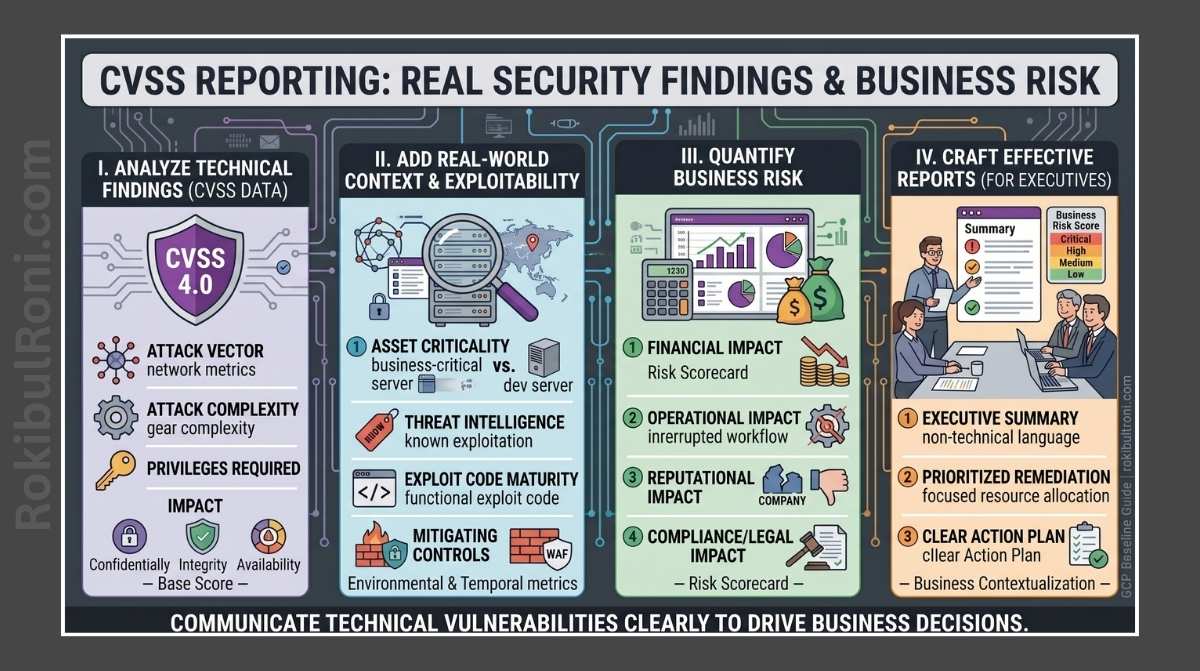
Assigning a severity label is the easy part. The hard part is writing a finding that an engineer can actually fix, a product manager can prioritize, and an executive can act on — without losing the technical truth somewhere along the way.
CVSS is a useful tool when it’s treated as a scoring framework, not a shortcut for thinking. A high-quality security report ties CVSS scores to evidence, business context, clear remediation guidance, and retest outcomes. Dropping a number on a finding and calling it done is what gives security reports a reputation for being ignored.
Why scanner severity isn’t the full picture
Automated scanner output is a starting signal, not a finished answer. Scanners don’t know your network architecture, your compensating controls, your regulatory obligations, or which services are actually business-critical. They apply a technical scoring model to what they can observe — which is useful but incomplete.
Here’s where the gaps typically appear:
| Dimension | What It Represents | Common Mistake |
|---|---|---|
| CVSS Base Score | Technical characteristics of the vulnerability itself | Treating the score as the only priority signal |
| Exploitability Context | How realistic exploitation is in your specific environment | Ignoring access constraints and trust boundaries |
| Business Impact | Operational, legal, financial, or reputational consequence | Writing vague impact statements without business mapping |
| Remediation Priority | Sequencing based on risk, effort, and service criticality | Prioritizing purely by scanner rank |
A critical-severity finding on an isolated internal test system with no sensitive data and strong network controls is a different conversation than the same finding on an internet-facing API that handles customer payment data. CVSS alone doesn’t tell you which one to fix first.
What CVSS actually is — and what it isn’t
CVSS (Common Vulnerability Scoring System) is a standardized framework for expressing the technical severity of a vulnerability using defined metrics. When analysts apply it carefully and consistently, it improves cross-team and cross-organization comparability.
The current widely-deployed version is CVSS 3.1, though CVSS 4.0 was released in late 2023 by FIRST and introduces more granular exploitability and safety metrics. Most organizations are still using 3.1 for day-to-day reporting, but it’s worth understanding 4.0 if you’re refreshing your vulnerability management program.
What CVSS doesn’t do: it doesn’t automatically account for your regulatory exposure, compensating controls, incident response readiness, or customer impact. Those require analyst judgment and documentation alongside the score.
Practical rules for using CVSS correctly:
- Always document the full vector string alongside the numeric score — the number alone is meaningless without it
- Keep scoring transparent and reproducible so another analyst reaches the same result
- Separate technical severity from business priority language; they’re related but not identical
- State your assumptions explicitly, especially when evidence is incomplete
Finding structure that actually drives action
A finding that stalls in the backlog is usually missing one of a few things: clear ownership, a specific affected asset, or remediation guidance someone can actually execute. The technical severity can be perfect and the finding still goes nowhere.
Here’s what a complete finding needs:
- Title — specific behavior, not just the vulnerability class name
- Affected asset — hostname, service, application component, and environment
- Severity — CVSS score, vector string, and severity band
- Description — what was observed during controlled testing
- Evidence summary — concise proof with appropriately redacted artifacts
- Business impact — plain-language consequence for operations, users, or compliance
- Remediation — actionable steps with a logical owner team identified
- References — relevant standard, CVE, or internal control mapping
- Owner and SLA — accountable team and expected fix window
- Retest status — pending, passed, failed, or partial, with date
| Field | Minimum Quality Bar |
|---|---|
| Title | Clearly describes the insecure behavior and affected function |
| Affected Asset | Specific service, endpoint, and environment — not just “web application” |
| CVSS | Score and full vector string documented together |
| Evidence | Timestamped, reproducible, safe — not raw scanner output |
| Business Impact | States what can happen to operations, data, or users specifically |
| Remediation | Actionable and assigned to a logical owner — not “apply patch” |
| Retest | Explicit status with date and tester notes |
Writing titles that communicate risk immediately
This is where most reports fail quietly. If the title is vague, readers have to dig through the finding before they understand what they’re looking at — and many won’t bother.
| Weak Title | Strong Title |
|---|---|
| ”Broken Access Control" | "Invoice Export Endpoint Allows Cross-Tenant Data Access for Standard User Role" |
| "Sensitive Data Exposure" | "Account Profile API Returns Full National ID Field to Low-Privilege Session" |
| "Authentication Issue" | "Password Reset Token Remains Valid After Successful Password Change" |
| "Rate Limit Missing" | "Login API Accepts Sustained High-Volume Requests Without Backoff or Lockout Controls” |
A good title tells the reader the behavior, the location, and the affected context — all in one sentence. If you can’t write a title like that, you probably don’t have a complete picture of the finding yet.
CVSS base metrics in plain language
Use this as a reference when scoring findings or calibrating analysts on a team. The goal is consistent, reproducible scoring — not just fast scoring.
| CVSS Metric | Plain-Language Meaning | Reporting Tip |
|---|---|---|
| Attack Vector (AV) | Where the attacker needs to be — network, adjacent network, local, or physical | Describe practical reachability in your environment, not just the theoretical maximum |
| Attack Complexity (AC) | How difficult the conditions are for a successful attack | Note if unusual prerequisites reduce real-world exploitability |
| Privileges Required (PR) | What access level the attacker needs before the attack | Tie this to your actual role model and identity controls |
| User Interaction (UI) | Whether another user must take an action for the attack to work | Describe realistic likelihood of that interaction in context |
| Scope (S) | Whether the impact crosses security boundaries to other components | Clarify system-to-system blast radius where relevant |
| Confidentiality (C) | Potential data exposure impact | Map to your data classification framework where possible |
| Integrity (I) | Potential for unauthorized modification | Link to transaction or workflow trust effects |
| Availability (A) | Potential service disruption | Describe the user-facing or business-facing service effect clearly |
Contextual adjustments that change remediation priority
Two findings with similar CVSS scores can have completely different practical urgency once business context is applied. Documenting that context is what separates useful risk communication from a list of numbers.
Context factors worth documenting in every finding:
- Internet-facing vs. internal-only segment
- Data classification — customer records, regulated data, credentials, versus low-sensitivity internal data
- Asset criticality — revenue path, identity platform, operational dependency, versus isolated sandbox
- Compensating controls — WAF, segmentation, detection coverage, workflow constraints
- Detection and response readiness — how quickly an attack would be detected and contained
| Context Signal | Priority Effect | How to Capture It |
|---|---|---|
| Internet-facing critical API | Increases urgency significantly | Document the exposure path and business dependency |
| Strong compensating control with validated efficacy | May reduce immediate urgency | Include evidence the control is actually working, not just configured |
| Regulated data present | Increases compliance and legal impact | Map to specific policy or compliance obligation |
| Isolated low-criticality sandbox | May reduce operational urgency | Confirm no production data linkage or trust relationship |
| Same weakness found repeatedly across multiple teams | Increases program-level risk | Flag as a systemic control gap requiring architectural attention |
Communicating findings to executives without losing technical truth
Executive readers need decision-ready clarity: what matters, why it matters now, and who is handling it. The mistake is either burying them in technical detail or oversimplifying to the point where the risk isn’t clear.
The format that works consistently:
- Open with the business effect, not the technical mechanism
- State the technical risk in one plain-language sentence
- Name the remediation owner and timeline
- Include residual risk if the issue isn’t fully resolved yet
- Put deep technical artifacts in an appendix
An example of what this looks like in practice:
“A permission check weakness in the customer billing API allows unauthorized viewing of other tenant invoice metadata under specific authenticated conditions. The issue scores high technically and affects externally exposed production services tied to finance workflows. Engineering ownership is assigned to the platform team, remediation is in progress, and retest is scheduled for the next release gate.”
That paragraph gives an executive everything they need to understand and act without requiring them to read a full technical breakdown. The technical detail still exists — it’s just in the appropriate section.
Common reporting mistakes that undercut credibility
These appear regularly in real reports and consistently reduce the report’s impact:
- Inflating severity without technical basis — claiming Critical when the CVSS vector doesn’t support it damages your credibility on findings that actually are critical
- Dramatic impact claims that aren’t backed by evidence — “an attacker could exfiltrate all customer data” needs to be grounded in what you actually observed
- Score without vector string — a CVSS number with no vector is unverifiable and unauditable
- Raw scanner output pasted as evidence — scanner output is a starting point, not a finding; it requires analyst interpretation
- Vague remediation guidance — “implement proper access controls” helps no one; name the specific check that needs to be added
- No ownership or SLA — findings without owners don’t get fixed
- No retest status — a finding without a retest plan has no defined lifecycle
- Unacknowledged assumptions — if you’re scoring based on assumed conditions rather than confirmed evidence, say so
Practical SLA mapping by risk profile
SLA decisions should combine technical severity and business context. Using CVSS score alone as the SLA driver leads to misaligned priorities — a Low severity finding on a revenue-critical system often warrants faster action than a High finding on a sandbox with no sensitive data.
| Finding Profile | Suggested Timeline Direction | Who to Align |
|---|---|---|
| High severity + internet-facing + critical asset | Fast-track remediation window | Engineering owner plus executive visibility |
| Medium severity + strong validated compensating controls | Standard remediation cycle | Engineering owner with security check-ins |
| Low severity + low criticality, no sensitive data | Planned backlog remediation | Product and security governance review |
| Recurring control gap across multiple teams or systems | Program-level remediation initiative | Security architecture and platform leadership |
Closure states that make audit straightforward
Ambiguous closure labels are one of the most common ways security programs lose track of real risk. Standardize these early so every stakeholder — engineering, security, audit — reads the same status the same way.
| Closure State | Meaning |
|---|---|
| Open | Risk confirmed; remediation has not started |
| In Progress | Remediation is underway; retest is pending |
| Mitigated Pending Retest | Control change deployed; validation scheduled |
| Closed — Retest Passed | Risk is no longer reproducible in approved retest |
| Accepted Risk | Business owner has formally accepted the residual risk |
“Closed” without a retest is not a real closure — it’s an assumption. A disciplined closure model is what makes CVSS reporting useful for ongoing security operations rather than just a point-in-time deliverable.
Reusable finding template
Use this as your default structure across penetration testing reports and vulnerability management outputs:
| Section | Prompt |
|---|---|
| Finding Title | What insecure behavior occurs, where, and under which role or context? |
| Affected Asset | Which exact system, endpoint, method, and environment is affected? |
| Severity (CVSS) | What is the score, vector string, and rationale for each key metric? |
| Description | What was observed during authorized testing? |
| Evidence Summary | Which artifacts prove the issue reproducibly and safely, with appropriate redaction? |
| Business Impact | What can this issue cause for operations, users, compliance, or trust? |
| Remediation Guidance | What specific engineering steps should be taken first? |
| Owner and SLA | Which team owns the fix, and what timeline is expected? |
| Retest Status | Pending, passed, failed, or partial — with date and tester notes |
Quality gate before publishing:
- Does the title communicate behavior and scope without opening the full finding?
- Is the CVSS vector present and internally consistent with the described impact?
- Is business impact specific and backed by evidence, not speculation?
- Can engineering execute remediation without follow-up clarification?
- Is there a defined retest plan with a named owner?
Maintaining a CVSS decision log
On mature security teams, scoring decisions get documented the same way architectural decisions do. This is especially important when findings go through review cycles, when scoring is contested, or when you need to demonstrate reasoning to an auditor.
A minimal decision log entry looks like this:
| Field | Example |
|---|---|
| Finding ID | WEB-012 |
| Vector String | CVSS:3.1/AV:N/AC:L/PR:N/UI:N/S:U/C:H/I:H/A:N |
| Key Assumptions | ”Endpoint reachable only from corporate IP ranges per firewall review” |
| Evidence | ”ACL confirms allowlist; request blocked when tested off-VPN” |
| Adjustments | ”Environmental score lowered due to verified network controls” |
| Owner and Date | ”Security Engineering / 2026-02-10” |
Environmental and temporal score adjustments are valid — but only when the underlying control or condition is verified with evidence, not assumed. If you can’t point to the evidence, don’t override the base score.
CVSS reporting becomes genuinely valuable when scoring is transparent, findings are structured for action, and closure is tied to real retest evidence. The discipline required isn’t complex — it’s consistent structure, honest evidence, and clear accountability from first finding to final closure.